Knee pain on the stairs, now at 25
Vijay is halfway down the stairs, late for work, when his knee catches. A sharp twinge, then a dull ache. He grips the railing and waits for it to pass. He is twenty-seven. His father is past sixty and has never had a day of knee trouble.
Scenes like this are no longer unusual. Knee pain used to be something our grandparents grumbled about, the price of a long life. Now it is showing up in people who have barely started their careers: software engineers, college students, gym regulars, weekend runners.
It isn’t bad luck. It is the body responding, quite predictably, to the way we now live. The encouraging part is that most of what drives it is within our control. This guide covers why it happens, what is going on inside the joint and the bone, which tests are worth knowing about, what to eat, how to move, and when a twinge should send you straight to a doctor.
The Queue at the Clinic Is Getting Younger
Orthopaedic surgeons across India describe the same shift. Ten years ago, says Dr Manoj Kumar of SIMS Hospital in Chennai, most of his knee patients were over 45. Today he regularly sees IT professionals and athletes in their twenties whose pain is getting in the way of everyday life.
Dr Anoop Khatri of Gleneagles Hospital in Mumbai has noticed a clear rise in patients aged 22 to 28. At Manipal Hospital in Pune, Dr Sinukumar Bhaskaran finds that many young patients walk in already frightened, convinced they have arthritis and asking whether they will need a knee replacement.
The joint is only part of the picture. The bone beneath it is under strain too. Osteoporosis was long thought of as an old person’s disease, but Dr Nikunj Agrawal of Max Hospital, Vaishali, now sees early signs of low bone density in people in their early forties, particularly women nearing menopause. He links the trend to diet, smoking, alcohol, inactivity and too little time in the sun.
Estimates commonly cited in Indian research suggest that roughly one in three women and one in eight men in the country have osteoporosis. The numbers shift depending on the study, the region and the age group surveyed. The direction does not: the problem is widespread, it is growing, and most people who have it don’t know.
Inside the Knee
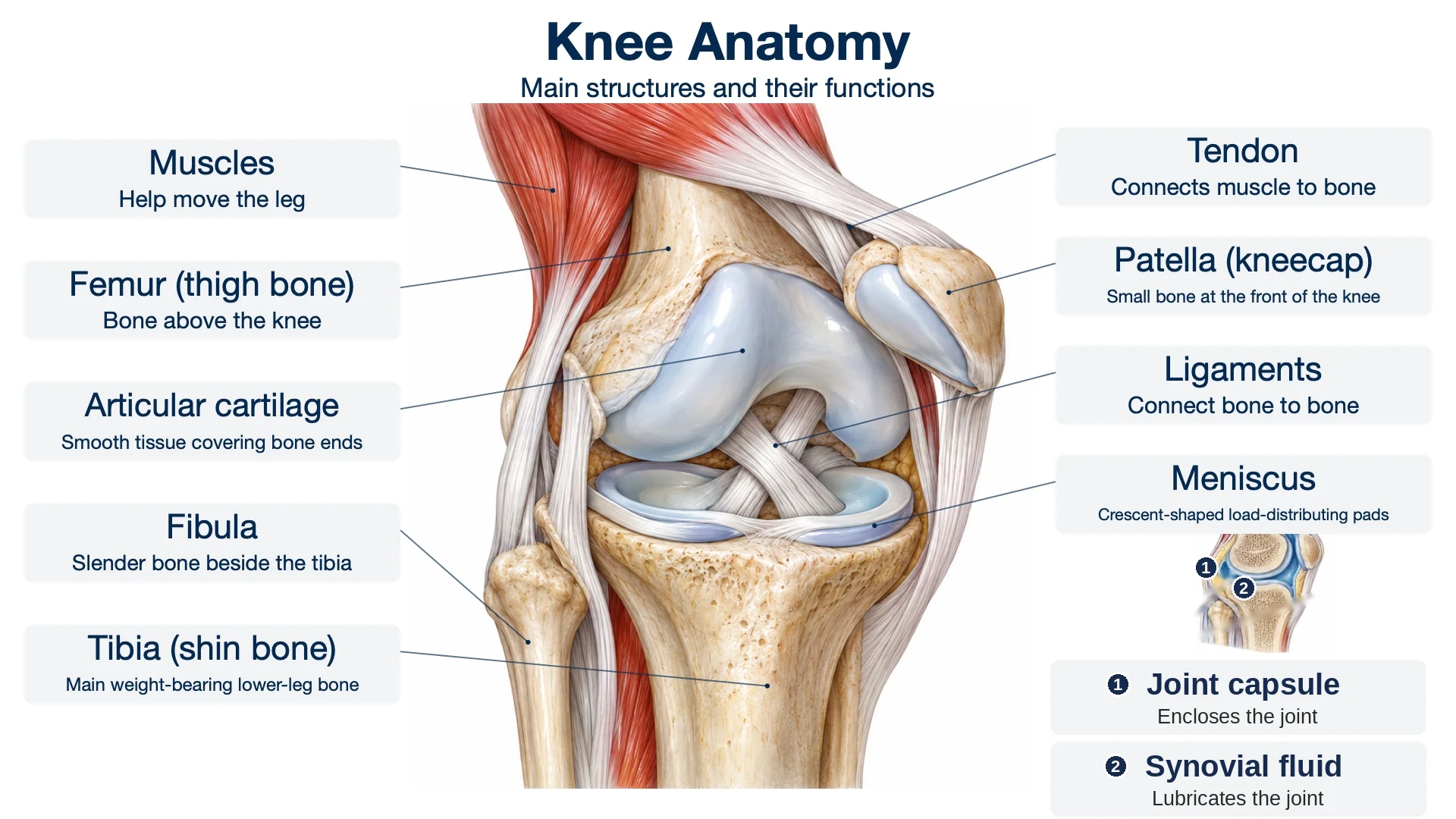
The knee carries more load than any other joint in the body. Three bones meet here: the thigh bone (femur), the shin bone (tibia) and the kneecap (patella). Their ends are coated in smooth cartilage, two rubbery, crescent-shaped pads called menisci sit between the femur and tibia to absorb shock, and tough bands called ligaments hold the whole structure together.
But the real protection comes from the muscles around it. The quadriceps at the front of the thigh, the hamstrings at the back, and the core muscles of the abdomen and lower back act as shock absorbers. When they are strong, they take much of the load every time you walk, run or climb stairs. When they are weak, that load goes straight through the joint.
Dr J. Pantala Rajakumaran, an orthopaedic surgeon at VS Hospitals in Chennai, recalls a 32-year-old who told him, “I barely exercise, yet my knees ache every evening.” The examination told the story: his thigh muscles were badly deconditioned and the joint was under constant stress. He didn’t need surgery. A simple strengthening programme was enough.
In many young patients, the knee itself isn’t the weak link. The muscles meant to support it are. Grasp that, and half the problem makes sense.
What Does “Worn-Out Cartilage” Actually Mean?
People often describe knee pain as their cartilage “wearing out.” Two structures usually get lumped together here. One is articular cartilage, the smooth, slightly springy layer that covers the ends of the bones, lets them glide without friction and spreads the load across the joint. The menisci are a form of cartilage too, which is why it helps to know exactly which part is affected rather than blaming “cartilage” in general. The other is synovial fluid, a slippery liquid inside the joint that lubricates it and feeds the cartilage.
Cartilage has one significant limitation: it has no blood supply. Skin and muscle are nourished by blood; cartilage is not. That is why, once damaged, it repairs itself poorly.
Movement is how it gets fed. Cartilage behaves like a sponge. Each time you put weight on the knee, it is squeezed and pushes out waste. When the pressure lifts, it draws in nutrients from the joint fluid. Sit still all day and that pump stops working, leaving the cartilage undernourished. This is why inactivity is so hard on the knee.
When cartilage breaks down, it thins, frays and gradually loses its smooth surface. The usual culprits:
Osteoarthritis: Repeated stress from excess weight, poor alignment or weak muscles causes tiny cracks in the cartilage. Low-grade inflammation follows, releasing enzymes that break the tissue down further, until bone can end up rubbing on bone. It is not simply wear and tear from walking too much, though. Osteoarthritis affects the whole joint, including the bone, the joint lining and the surrounding tissue.
Injury: A hard knock in sport can damage cartilage directly. Ligament or meniscus injuries left untreated make the knee unstable, and the cartilage wears faster.
Inactivity: Without regular movement, cartilage loses its supply of nutrients and weakens.
Rheumatoid arthritis: The immune system attacks the joints by mistake, and the resulting inflammation damages cartilage. It can strike young adults, especially women.
Infection: A bacterial infection in the joint can destroy cartilage within days. A single joint that suddenly becomes very painful, hot and swollen, especially if you can’t put weight on it, is a medical emergency. Fever may or may not be present, so don’t wait for one.
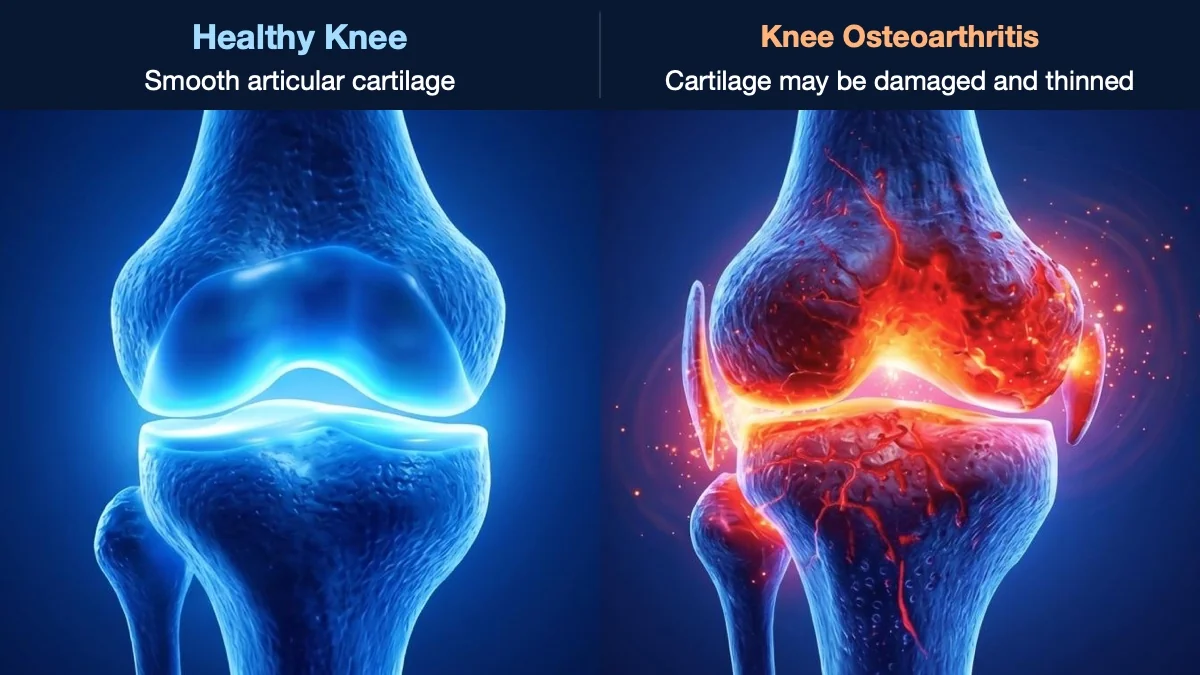
As the cushion thins, the bones take abnormal pressure and can develop small bony outgrowths at their edges (bone spurs), bringing more pain, stiffness and swelling. Caught early, though, this process can often be slowed or stopped. Losing excess weight, building muscle strength and moving well are the main tools.
Why Young Knees Are Hurting
1. Too much sitting. Many young adults now spend eight to ten hours a day seated, often on a sofa or in bed with a laptop balanced on their knees. The knee was never designed for that, says Dr Rajakumaran. He describes a 27-year-old who spent months working from his sofa during the pandemic and ended up with both knee and back pain, without any injury at all. Years of slumped sitting can start the cartilage breakdown on their own.
2. The weekend warrior pattern. Dr J.V. Srinivas of Aster RV Hospital in Bengaluru calls this one of the leading causes of knee pain in young people. A week at a desk weakens the thigh and hip muscles that stabilise the knee. Then comes a Sunday burst of cricket, football, a long run or an ambitious gym session, and the joint can’t cope. He singles out running and gym work done without proper technique or build-up.
3. Kneecap pain. The most common diagnosis in younger patients is patellofemoral pain, where the kneecap doesn’t track smoothly in its groove and causes pain behind or around it. It tends to flare on the way downstairs or after sitting for a long time, which is why it is sometimes called “moviegoer’s knee.” Posture and muscle weakness are usually behind it, and according to Dr Bhaskaran it responds very well to physiotherapy.
4. Extra weight. Each extra kilogram of body weight adds roughly four kilograms of force through the knee with every step. Carry ten extra kilos and your knees are absorbing around forty more with each stride. Fat tissue also releases chemicals that drive inflammation, which speeds up cartilage damage. Vijayashree, chief dietitian at MGM Healthcare in Chennai, says overweight young people are putting serious strain on their knees just going about their day.
5. Old injuries left untreated. A twist in a college football match, a sprain you walked off, can resurface years later. Dr Srinivas warns that untreated ligament tears and meniscus injuries often catch up with people in their thirties. A ligament injury that never healed properly can leave the knee permanently unstable and set the stage for early arthritis.
6. Posture, footwear and technique. Flat feet, a weak core, poorly fitting shoes and exercises done with bad form all add to the load on the knee. Doctors say fixing posture, gait and footwear alone can make a real difference. Long periods sitting cross-legged on the floor and constant stair climbing can also aggravate kneecap pain, according to Dr Bhaskaran.
7. Nutritional gaps. Vitamin D and calcium deficiencies are extremely common in India, and Dr Srinivas notes that both weaken bones and joints and raise the risk of knee pain. Which brings us to the part of the story you can’t see: the bones themselves.
The Hidden Problem: Your Bone Bank
Bone is not inert. It is living tissue, constantly being broken down and rebuilt. Through childhood, the teenage years and early adulthood, the body builds more than it loses. Somewhere between 25 and 30, bones reach their peak strength, what doctors call “peak bone mass.” From then on the balance slowly tips the other way.
Think of it as a bank account. Whatever you deposit before your late twenties is the reserve you live on for the rest of your life. “The higher the peak we reach, the later osteoporosis we get,” says Dr Agrawal. The worrying part is that many young people are drawing down that account at exactly the age they should be building it.
If you are past thirty, it isn’t too late. Your chances of adding to the reserve shrink, but you can protect what you have for life. From your mid-thirties onwards, the goal is to hold on to the strength you have and slow its decline.
What is osteoporosis? It is a condition in which bones lose density and structural strength, becoming porous and prone to breaking after even a minor fall. Its milder forerunner, osteopenia, means bone density is below normal but not yet low enough to be called osteoporosis.
It gives no warning. That is what makes it dangerous. In its early stages, osteoporosis causes no pain and no symptoms. Many people only find out when a bone breaks from a small slip, a stumble on a step or lifting a suitcase.
An important distinction: knee pain is not osteoporosis. Knee pain usually comes from muscles, cartilage, ligaments or the kneecap. Osteoporosis concerns the strength inside the bone. Yet the two share the same roots: too little movement, too little sun and too little good food. Knee pain is the warning you can feel. Bone loss is the one you can’t.
The Habits Quietly Eating Away at Our Bones
Bone health is built on habits sustained over years, says Dr (Maj.) Mukesh Garg, Director of Orthopaedics at Sarvodaya Hospital in Faridabad. These are the habits he and other specialists flag most often.
Too little sun. Without vitamin D, the body cannot absorb calcium properly, however much of it you eat. India has no shortage of sunshine, yet vitamin D deficiency is widespread here, thanks to air-conditioned offices, car commutes, indoor lives and polluted skies.
Use it or lose it. Bones, like muscles, strengthen in response to load. Walking, climbing stairs, dancing and lifting weights all tell the skeleton to stay strong. Spend the day sitting and that signal never comes. “The more we move around, the better our bone and joint health will be,” says Dr Agrawal.
Soft drinks pushing out milk. A glass of buttermilk after lunch was once standard in many Indian homes. Today it is just as likely to be a fizzy drink. The real problem, Dr Garg explains, is that sugary drinks crowd out calcium-rich ones like milk, curd and buttermilk.
Too much salt. A salty diet increases the amount of calcium lost in urine. Pickles have always been part of the Indian table; add crisps, instant noodles, fast food and late-night takeaways, and the salt load climbs fast.
Crash diets and being underweight. Fad diets aimed at rapid weight loss often shortchange the body on protein, calcium, magnesium and vitamin K, all essential for bone. Being significantly underweight is bad for bones, and so is obesity. Dietitian Vijayashree sees two very different groups among young people: those chasing extreme fitness goals on unbalanced high-protein diets, and those living on salty, calorie-heavy fast food. Neither group is getting the nutrients that count.
Smoking and heavy drinking. Tobacco interferes with the cells that build new bone and with the body’s use of calcium. Heavy drinking disrupts vitamin D metabolism, undermines nutrition and makes falls more likely. Quitting smoking is good for your bones as well as your heart and lungs.
Some medicines and medical conditions. Long-term steroid use is a well-known cause of bone loss, and certain anti-seizure drugs and cancer treatments can also thin bones. Thyroid disorders, low testosterone in men, rheumatoid arthritis, kidney disease and diabetes can all affect bone health. In coeliac disease, an immune reaction to gluten, the gut struggles to absorb calcium and vitamin D. Frequent bloating, stomach pain or diarrhoea deserves a proper medical check rather than another antacid. If you take any of these medicines, do not stop on your own. Just ask your doctor about your bone health.
Women: A Higher Risk
Women are more vulnerable to bone loss largely because of oestrogen, a hormone that helps keep calcium locked inside bone. As menopause approaches and oestrogen falls, bone loss accelerates. Dr Ruma Sinha, a senior gynaecologist at Apollo Hospitals in New Delhi, puts it plainly: bone loss begins silently in the forties, especially in women.
Mothers often come last. Many mothers make sure everyone else at the table gets their milk and curd, then eat whatever is left. They spend little time in the sun and brush off their own aches, and even Sunday rarely brings them a real break. Every woman over forty should raise bone health with her doctor at least once. Women who reach menopause early, or who have had their ovaries removed, should be assessed sooner.
A warning for young women and their parents. Cutting food drastically and exercising hard to stay slim can leave the body short of energy. Periods become irregular or stop altogether, a sign that oestrogen has dropped and bones have lost a key protection. A young woman can look perfectly fit while her bones quietly weaken. Irregular or missed periods should never be written off as “just stress.” See a gynaecologist. And if you want to lose weight, do it with guidance from a doctor or nutritionist, not from social media.
Warning Signs: When to See a Doctor
See a doctor promptly if your knee:
– Hurts even when you rest
– Hurts more at night
– Is swollen
– Locks suddenly, or clicks and catches when you move it
– Gives way, or feels unstable when you walk
– Won’t bend or straighten fully
– Suddenly becomes very painful, hot and swollen so you can’t bear weight on it (go to hospital straight away, even without a fever)
– Made a “pop” during sport and swelled up soon after (a possible ligament tear)
Unexplained weight loss also warrants a check-up.
Any knee pain that lasts more than a few days is worth having looked at.

For your bones, watch for:
– A fracture from a minor slip or fall. This is the most important warning sign
– Losing height or developing a stoop
– Back pain that won’t go away
– A weakening grip
– Irregular or missed periods in young women
No single sign proves you have osteoporosis, and not every backache or tired day is a bone problem. But pain that keeps coming back shouldn’t be ignored either. Finding the cause is always better than reaching for painkillers.
Which Tests, and Who Needs Them?
The first test is a doctor’s examination. An orthopaedic specialist will ask where, when and how your knee hurts, examine it, and then decide what investigations, if any, you need. The tests below are the ones most commonly used. You don’t need all of them, and none should be done without medical advice.
| Test | What it shows | Typically used when |
|---|---|---|
| X-ray | Bone alignment, narrowing of the joint space, signs of wear | The first imaging test for knee pain |
| MRI scan | Soft-tissue injuries: ligaments, meniscus, cartilage | After a sports injury, or if the knee locks or gives way |
| Vitamin D (25-OH), calcium | Whether the body has the nutrients bones need | Persistent aches or an indoor lifestyle, on a doctor’s advice |
| Thyroid (TSH) | Hormone problems that affect bone | Fatigue, weight changes or signs of bone weakness |
| ESR, CRP, RA factor | Inflammation and autoimmune causes such as rheumatoid arthritis | Both knees or several joints hurting, morning stiffness |
| Uric acid | Gout (crystals in the joint) | Sudden, severe pain with red, hot swelling |
| Coeliac test (tTG antibody) | Gluten intolerance affecting nutrient absorption | Ongoing gut problems alongside weak bones |
| DEXA scan | Bone mineral density | People with risk factors and women over 40, on a doctor’s advice |
| FRAX assessment | 10-year probability of a fracture | Adults over 40, depending on risk factors |
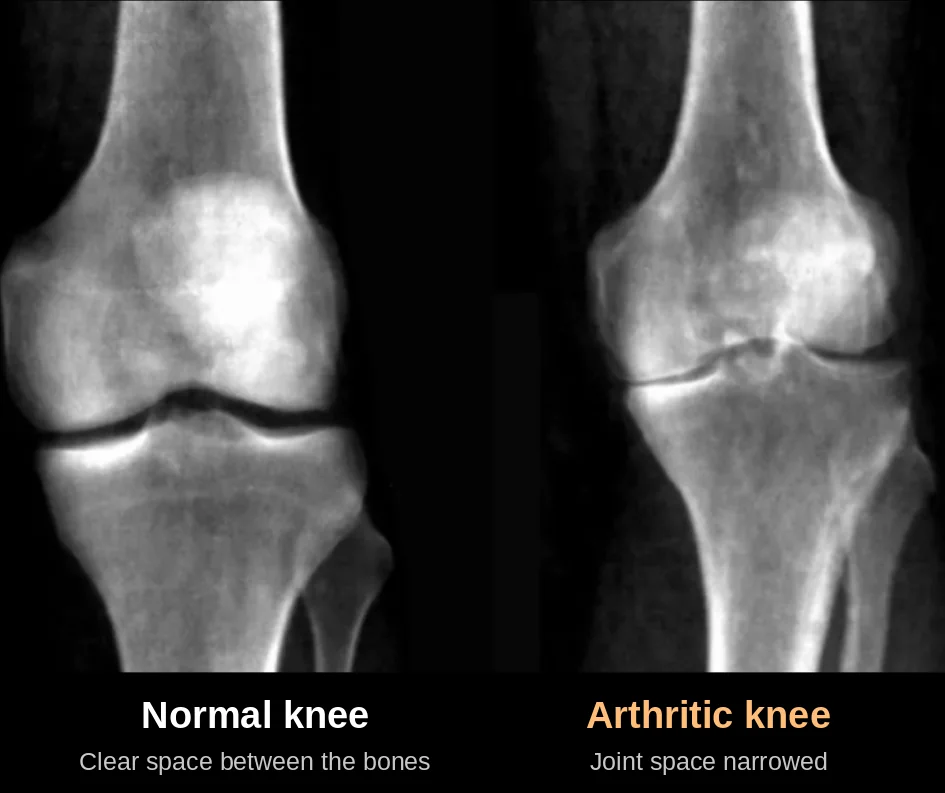
About the DEXA scan. This is the standard test for osteoporosis: painless, quick (about five minutes) and usually focused on the lower spine and hip. FRAX is a risk calculator developed around World Health Organization criteria that combines age, weight, family history, lifestyle and medication to estimate fracture risk. It is designed for people over 40.
Reading a DEXA result when you’re young. A DEXA report includes two scores. The T-score compares your bone density with that of a healthy young adult. The Z-score compares it with people of your own age. For younger adults and women who haven’t reached menopause, doctors rely on the Z-score alongside your medical history, and if density is low, they look for an underlying cause such as an illness or medication. Don’t diagnose yourself from a single number on the report. And remember: DEXA measures bone density only. It tells you nothing about the cartilage in your knee.
Most healthy people in their twenties and thirties don’t need a DEXA scan. Ask your doctor about earlier testing if you:
– Have broken a bone in a minor fall
– Have a parent or grandparent with osteoporosis or a hip fracture
– Take steroids long-term
– Reached menopause early, or are a young woman whose periods have stopped for a long time
– Have thyroid disease, coeliac disease, kidney disease, rheumatoid arthritis or diabetes
– Are a woman approaching menopause, a man with low testosterone, or very underweight
Dr Garg advises everyone over 50, and all women after menopause, to discuss bone density screening with their doctor.
Eating for Strong Bones
Before reaching for supplements, look at your plate. Dr Agrawal’s rule for patients is simple: “whites and greens.” The whites are milk, curd and paneer; the greens are leafy vegetables. In an Indian kitchen, that might look like this:
Calcium: milk, curd, buttermilk, paneer, ragi (finger millet, as porridge or ragi balls), sesame seeds (as chutney powder or sesame sweets), soya, calcium-set tofu, and greens such as moringa (drumstick) leaves and amaranth. Not all greens are equal, though. Spinach contains calcium, but its oxalates block much of it from being absorbed, so don’t count on spinach as a calcium source. If you avoid dairy, check labels for calcium-fortified foods.
Protein: dal, chickpeas, moong, cowpeas, eggs, fish, curd.
Vitamin D: few foods contain much. Egg yolks, oily fish such as sardines and mackerel, and fortified milk and cooking oils help a little. Sunlight remains the main source.
Anti-inflammatory foods: colourful fruit and vegetables such as oranges, guava, carrots, papaya and leafy greens.
The ragi porridge, buttermilk and sesame sweets of our grandparents’ kitchens are exactly what nutritionists now recommend. What we dismissed as old-fashioned turns out to be some of the best food there is for bones. Just be wary of adulterated milk and curd when you buy them.
Cut back on: soft drinks, packaged snacks, excess salt, processed food and late-night meals.
On sunlight. A walk outdoors in the morning or evening, with some sun on your arms and legs, is a good habit. How much vitamin D your skin makes, though, depends on your skin tone, the season, pollution and how long you’re outside. If you think you might be deficient, don’t start high-dose tablets or injections on your own. Get a blood test and take only what your doctor prescribes; too much vitamin D is harmful too. Keep in mind that vitamin D deficiency and osteoporosis are separate diagnoses, and that calcium alone isn’t enough. Bones need protein, vitamin D and an overall balanced diet. Supplements are no substitute for proper meals.
Simple Exercises and Better Posture
You don’t need an expensive gym membership to protect your knees. Dr Rajakumaran recommends a handful of exercises you can do at home:
1. Straight leg raise: Lie on your back with one knee bent. Keeping the other leg straight, lift it slowly and lower it again. A gentle first step for the thigh muscles.
2. Wall sit: Lean your back against a wall and slide down as if sitting on an invisible chair. Hold for a short while, keeping your knees behind your toes.
3. Step-up: Step slowly up onto a low, sturdy stool or step and back down, one leg at a time.
4. Hamstring stretch: Gently stretches the muscles at the back of the thigh.
5. Plank: Builds core strength.
6. A brisk 30-minute walk every day: Good for bones, joints and heart alike.
Yoga, swimming and cycling build strength without overloading the knees, while walking, stair climbing and weight training help keep bones strong. As a general guide, adults should aim for at least 150 minutes of moderate activity a week plus muscle-strengthening exercise on at least two days. If you’re out of the habit, start small and build up gradually.
Three ground rules:
Build up slowly. Don’t spend all week sitting and then play two hours of football on Sunday. Warm up before sport and stretch afterwards.
Keep at it. “Most people stop exercising as soon as the pain eases,” says Dr Rajakumaran. “It should be like brushing your teeth, something you do every day.” “I’ll start tomorrow” is the real enemy here.
Stop if it hurts. If you already have knee pain or an old injury, start exercising only under a physiotherapist’s guidance. Every body and every problem is different, and an exercise that helps one person can harm another.
At your desk:
– Stand up and walk for a couple of minutes every 30 to 45 minutes
– Don’t work from the sofa or bed; use a proper desk and chair
– Sit with both feet flat on the floor and your knees roughly level with your hips
– Take phone calls standing or walking, and use the stairs instead of the lift when you can
– Wear well-cushioned shoes that fit, and replace running shoes once they’re worn out
Myths and Facts
| Myth | Fact |
|---|---|
| Knee pain only comes with age | People in their twenties are now regulars at orthopaedic clinics. Lifestyle, not age, is usually the cause |
| If your knee hurts, stop exercising | Without movement, cartilage goes unnourished and muscles weaken further. The right exercise is part of the treatment; a physiotherapist can tell you which |
| Knee pain means you’ll need surgery | Only about 2% of people under 60 with knee pain need surgery, according to Dr J.V. Srinivas. The other 98% can manage it with weight loss and exercise |
| Knee pain means my bones are thinning | Not so. Knee pain is mostly about muscles, cartilage and ligaments. Osteoporosis usually causes no symptoms until a bone breaks |
| I work out every day, so my bones must be strong | Poor nutrition, extreme dieting or overtraining can weaken the bones of people who look very fit |
| In a country this sunny, we can’t be short of vitamin D | Vitamin D deficiency is very common in India, largely because so many of us live and work indoors |
| You can’t take too much vitamin D | You can, and it is harmful. Get tested and take only the dose your doctor recommends |
| Painkillers are enough | Painkillers mask the symptom, not the cause. Taken long-term without medical advice, they can harm the stomach and kidneys |
| After thirty, there’s nothing you can do for your bones | You can no longer build much new bone, but you can protect what you have for the rest of your life |
The Bigger Picture
Our grandparents walked to the fields, drew water from wells, sat on the floor and got up again dozens of times a day, and worked in the sun. They ate millets, drank buttermilk and filled their plates with greens. They never set foot in a gym, yet their knees carried them well into their eighties. We have traded that life for comfort, and our children’s knees are paying for it.
For parents: your children’s bone bank is built at home. Swap the phone for a ball, and send them out to play in the evenings. Pack sesame sweets instead of crisps, and keep buttermilk in the fridge instead of cola. Pay attention if your daughter’s periods change, or if she becomes preoccupied with getting thin. And remind the mother who looks after everyone to look after her own bones too.
For employers: you depend on your people’s minds, so look after their knees as well. Good chairs, regular breaks to stand and move, and posture awareness are not costs but investments. Help remote staff set up a proper workstation at home.
For schools and colleges: a school without a playground, or a college that gives the PE period away to exam preparation, is quietly draining its students’ bone reserves. Doctors say teaching posture and ergonomics early can prevent years of damage.
For young people: your knees need to last you another fifty or sixty years. A twinge at twenty-five is an early warning. Listen to it rather than silencing it with a painkiller. The fix rarely lies in an operating theatre. It lies in your daily routine: move more, build strength, eat well and sit well.
What you invest in your bones in your twenties, they pay back in your sixties.
Disclaimer: This article is for general information only and is not a substitute for professional medical advice. Always consult a qualified doctor or physiotherapist before starting any medication, supplement or exercise programme.