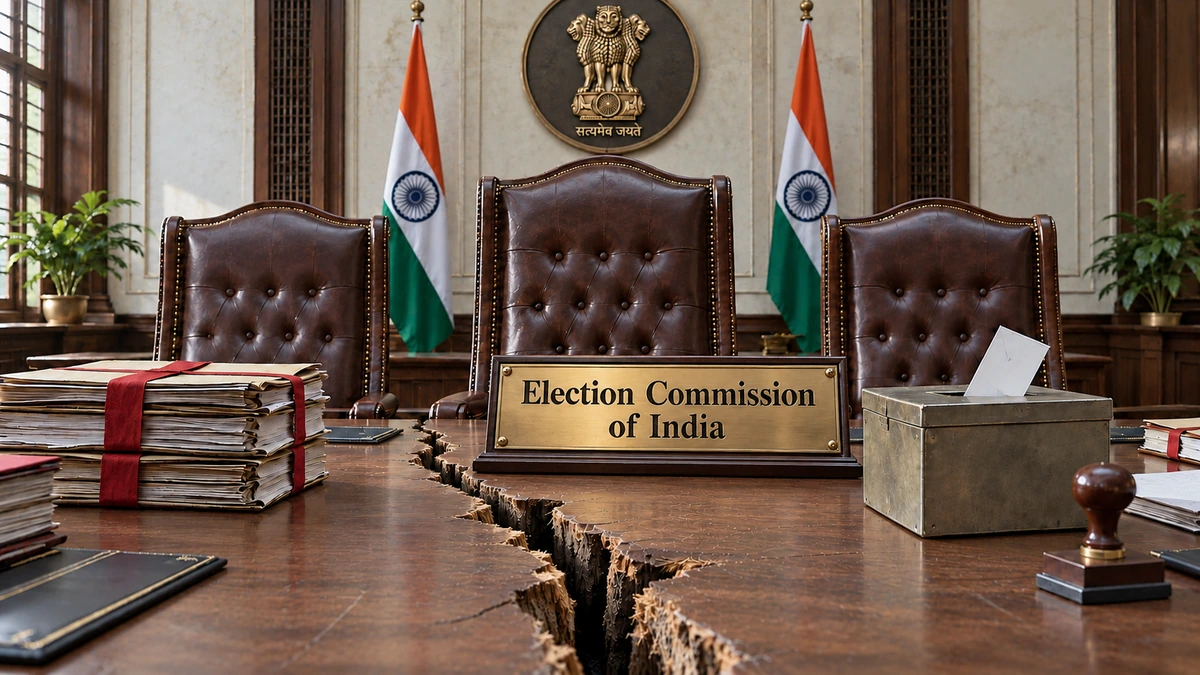
A commission divided (illustration)
The Election Commission of India has filed a counter-affidavit in the Supreme Court. Read closely, it describes something other than a quarrel between political parties: a dispute rooted in the commission’s own internal administration and in the nationwide Special Intensive Revision (SIR) of the electoral rolls.
It began with an internal work-allocation order issued on July 28 by Senior Deputy Election Commissioner Maneesh Garg. With the SIR at a critical stage, the order reshuffled responsibility for the commission’s IT systems and the supervision of the voter database. Two election commissioners, Sukhbir Singh Sandhu and Vivek Joshi, objected, and the dissent spilled into the open when each of them wrote separately to the Cabinet Secretary.
The commission told the court that the two commissioners had used their 2–0 majority to halt the order, so the system suffered no damage. It conceded that the online Form 6 had caused confusion, and said an order of October 21 had fixed the problem by separating Form 6 from the SIR declaration.
The opposition seizes the moment
Political observers note that the opposition refused to treat a deputy commissioner’s work-allocation order, and two commissioners’ letters to the Cabinet Secretary, as a mere office squabble. It presented them to the country as direct evidence of “indirect government control over the Election Commission” and of “the collapse of institutions”.
Setting aside an IT dispute that few ordinary voters would follow, the opposition tied it to the flaws of the nationwide SIR and to the deletion of voters’ names, and the story caught fire. When the commission acknowledged the letters in its affidavit, opposition parties said their charges now carried an official stamp, called the commission’s stand “deceitful”, and claimed fresh legitimacy for their protests.
They made the issue a central plank of the “Save Democracy” rally planned in Delhi on November 1, pressing the legal fight in the Supreme Court while sharpening the street fight against the ruling BJP. What was, administratively, a passing internal disagreement became, through timing and a well-crafted narrative, a national political storm.
With the affidavit confirming that Sandhu and Joshi wrote separately to the Cabinet Secretary, the opposition alliance argues it now has strong evidence for its old charge: that the government controls the Election Commission by proxy.
The 14 notes

According to media reports, the heart of the dispute lies in 14 internal notes and objections that Sandhu and Joshi recorded over ten months. What makes them significant is their timing. These were not deliberations before a decision. They were reportedly written after the fact: after a decision had been made under Chief Election Commissioner Gyanesh Kumar, after a legal order had gone out, or after a new software system had already been built. “How was this decision taken without our knowledge, without consulting us?” That, the reports say, is the question the two commissioners put on the official files, fourteen times.
Nor were these petty office disputes. They went to the commission’s most critical functions. The commissioners worried that additions, deletions and restorations of voters’ names during the SIR were being changed without their knowledge. They objected to changes in Form 6, the form used to enrol new voters, that they considered contrary to the rules. They wrote notes on technical matters: the centralisation of the national voter database, IT software modules developed without their approval, and new limits on the powers of electoral registration officers in the field. They also recorded their unhappiness with appeal procedures arising from roll revisions in states such as Goa and West Bengal.
In its affidavit, the commission did not deny that the 14 notes exist. It explained them differently. Questions, suggestions and notes written by individual commissioners while a file is being processed, it argued, cannot be treated as “final decisions of the commission”. Differences of opinion are natural in any institution, it said, and the three main SIR orders, issued in June 2025, October 2025 and May 2026, carried the signatures of all three commissioners and were issued unanimously.
The opposition reads it differently. If two members of a constitutional body had to write fourteen notes in ten months complaining that decisions were being taken behind their backs, the body is being run single-handedly. The commission insists it acted lawfully throughout. The timing and weight of these 14 notes are now at the centre of the legal battle in the Supreme Court.
The two commissioners say they learnt of certain software changes and form updates for the SIR only after these had reached the field. Arguing that they had been kept out of the decision-making and that files had not come to them as procedure requires, they recorded their objections post facto. One question runs through the notes: “How were these directions issued without consulting us?”
The commission’s answer is that commissioners routinely record questions and dissent while a file is moving. However many notes are written internally, the final orders carried all three signatures, and were therefore unanimous. In short, the commissioners did object in writing, and only after the decisions had been taken. But by the time the binding orders were issued, the commission says, everyone had signed on.
The commission also addressed the July 28 order that provoked the letters to the Cabinet Secretary. It told the court the order had been issued by an Additional Secretary-level officer on deputation who exceeded his authority; that it was withdrawn in full by a joint direction on July 30, the day after the commissioners wrote their letters; and that it was therefore never implemented. Action would follow against the officer, it said. According to the affidavit, even the Chief Election Commissioner did not know about the order in advance.
The opposition does not buy the claim that one officer acted alone. At the headquarters of the Election Commission, where the rules are among the strictest in the country, an order that touched the standing of the CEC and the other commissioners and reshaped control over IT could hardly have been issued by a bureaucrat on his own initiative. Without Gyanesh Kumar’s oral approval or backing, the opposition alleges, the officer would never have dared.
Why write to the Cabinet Secretary?
If this was simply one officer’s mistake, the commissioners could have complained to the CEC and had the order cancelled internally. Instead, they wrote to the Cabinet Secretary, an official outside the commission. That, the opposition argues, shows they had no faith in the CEC’s conduct within their own institution, and felt compelled to take the matter to the top of the government.
It is also alleged that when Commissioner Vivek Joshi asked for the original file on the order, the administration wing withheld it. If an IAS officer dared to keep files from a constitutional commissioner, the opposition suspects the head of the institution was behind him. The commission’s records say the order was issued by an officer overstepping his authority without the CEC’s knowledge; the opposition says no officer could take so large a decision without Gyanesh Kumar’s involvement or tacit consent. This is likely to become the most heated point in the Supreme Court.
No action against Garg, yet
RTI documents made public in October 2026 confirmed that the two commissioners had complained about Maneesh Garg to Cabinet Secretary T.V. Somanathan. The Cabinet Secretariat declined to order an inquiry or take immediate disciplinary action. It merely forwarded the complaints to the Department of Personnel and Training, which handles IAS postings, and to the CEC’s office. The government did not intervene directly.
There is every likelihood that Garg will become the scapegoat. When a dispute erupts between the constitutional authorities at the top of an institution, the institution often tries to wash its hands by sidelining or punishing the bureaucrat at the centre of it. In its counter-affidavit, filed with the unanimous approval of all three commissioners, the commission formally recorded that Garg issued the July 28 order beyond his authority. In effect, to protect itself and to assure the court that the CEC had no role, it has placed the entire blame on him.
The affidavit adds that action will be taken against the officer who broke the rules and issued so sweeping an order without anyone’s knowledge. That opens the way to a departmental inquiry, a suspension or memos, or the immediate end of his deputation and a return to his home cadre.
Garg is a 1996-batch IAS officer of the Himachal Pradesh cadre and has served as that state’s Chief Electoral Officer. Being caught up in such a controversy while on deputation to the Election Commission could seriously damage his prospects of promotion and of key postings at the Centre.

“Whoever encouraged him from behind the scenes, it was his signature on the order. Before the law, he is the one who will have to answer.
The legal battle ahead
It is an open secret that Garg could not have issued so far-reaching an order on his own. Whoever encouraged him from behind the scenes, it was his signature on the record, and before the law he is the one who will have to answer. Unless the Supreme Court takes a serious view and orders a deeper inquiry, asking how an officer found such courage and who the real mastermind was, the commission and the government are likely to try to close the matter by holding Garg alone responsible.
According to the public interest litigation filed in the Supreme Court and to legal sources, opposition lawyers are preparing a strong counter so that the commission cannot escape by presenting Garg as a mere scapegoat. They plan to turn the commission’s own admission, that Garg exceeded his authority, against it. How, they will ask, could an Additional Secretary-level officer take a major policy decision, shifting control of the IT division and the voter database, without the knowledge of the CEC who heads the commission? And if the CEC genuinely did not know, does that not show he has lost control of his own institution? They are invoking the principle of command responsibility: when a subordinate errs, the duty of supervision rests with the head.
They will also point out that when Election Commissioner Vivek Joshi, a constitutional authority, asked to examine the original file, the administration wing under Garg allegedly withheld it from him. Where would an IAS officer find the nerve to keep a file from a commissioner far senior to him? The opposition will argue that oral instructions or protection from Gyanesh Kumar must lie behind it, and that the case cannot be closed with action against Garg alone.
Through petitioner Shailendra Mani Tripathi, the opposition is pressing not merely for administrative action but for a criminal investigation by a Special Investigation Team into CEC Gyanesh Kumar, Deputy Commissioner Maneesh Garg and IT chief Seema Khanna. Its lawyers will also ask the court to order the original notings and file records from all 14 occasions to be produced in a sealed cover. The language the commissioners used in those notes, protesting that the law was being violated and that there were authoritarian tendencies, would, the opposition hopes, prove that these were serious objections and not “routine suggestions”.
What the July 28 order actually did
According to the opposition, Garg’s July 28 order took the commission’s most sensitive responsibilities, the IT division and the voter database, away from Deputy Election Commissioner Sanjay Kumar and placed them directly with Seema Khanna, the Director General (IT). That removed the layer of supervision a deputy commissioner provides between the IT division and the commissioners.

The commissioners had warned from the start that such a change would centralise the IT division completely and weaken the powers of officers in the field. In India, the legal authority to revise electoral rolls rests with electoral registration officers (EROs) on the ground. Moving the oversight of, and access to, that system to headquarters in Delhi undermines the independence of local officers. Without administrative control over the software and the IT division, the fear is that voters could be deleted arbitrarily in the name of algorithms. That would amount to taking away voters’ most basic right.
The opposition alleges that someone anticipated how strongly the commissioners would object if they discovered such sensitive IT changes made without the commission’s approval, and tried to keep the file out of their sight. It says the commissioners were not consulted before the order was issued, and that the administration wing kept the file away from Joshi until the order had taken effect, so that the breach of rules would never enter the official record.
Had the file reached Joshi in time, he would have recorded a written objection. Once a commissioner records an objection on a file, neither the CEC nor any officer can override it. Only if no such record exists can it later be claimed that “everyone knew about this decision”, or that “it was just one officer’s mistake”.
In administrative language, this is a fait accompli: knowing a decision is wrong, you issue it as an order before the commissioners find out. Once the order is out, any objection can be brushed aside as too late. That, the opposition says, was the strategy. Congress and other parties allege that the commissioners, fed up with “authoritarian tendencies” that extended to hiding files inside their own institution, set the internal fight aside and wrote straight to the country’s top bureaucrat, and that the force of those letters, and the fear of the courts, is why the commission had to withdraw the order within two days, on July 30.
A breach of protocol?
By the rules and conventions of administration, two election commissioners writing directly to the Cabinet Secretary is a highly unusual step. The posts of the Chief Election Commissioner and the election commissioners are constitutional, and their status is on a par with judges of the Supreme Court. Some experts believe that writing to the Cabinet Secretary, who ranks lower in protocol, to complain about a deputy commissioner of their own commission amounts to a breach of protocol.
Under Article 324, the Election Commission is an independent constitutional body, and the government has no business in its internal affairs. Opposition parties and analysts argue that by writing to the Cabinet Secretary, the head of the government machinery, to settle an internal dispute over the distribution of work, the commission has dragged the government into its own quarrels.
The commissioners’ side has an answer. Garg is an IAS officer on deputation from the central government, and the service rules, transfers and deputations of IAS officers at the Centre fall within the purview of the Cabinet Secretariat. They wrote, their supporters could argue, only to bring his conduct and his disputed order to the attention of his parent authority.
Writing such a letter is no crime, but it is not the proper course under institutional protocol. That is why the commission, while acknowledging the letters in its affidavit, told the Supreme Court that the commissioners had used their 2–0 majority to cancel the disputed order, settling the matter internally.
Not the first rift
Until 1993, the Election Commission had a single member, and T.N. Seshan was the Chief Election Commissioner. To rein him in, the government of the day appointed two more commissioners, M.S. Gill and G.V.G. Krishnamurthy, turning it into a three-member body. Seshan went straight to the Supreme Court to challenge the curbs on his powers.
In 1995, in a landmark judgment, the court ruled that while the CEC comes first, the other two commissioners have equal powers, and that all decisions must be taken by majority or consensus.
“Such rifts used to stay behind closed doors. This time, court affidavits have put them on the record.
In 2009, just before the Lok Sabha elections, another dispute shook the country. Chief Election Commissioner N. Gopalaswami made serious allegations against his colleague Navin Chawla, accusing him of partisanship in favour of the Congress, and on his own initiative recommended to the President that Chawla be removed. The government rejected the recommendation. When Gopalaswami retired, Chawla succeeded him as CEC.
During the 2019 general election, the commission gave clean chits on complaints that senior leaders of the ruling party had violated the Model Code of Conduct. Election Commissioner Ashok Lavasa disagreed. Protesting that his dissent was not being recorded in the commission’s official orders, he stopped attending its meetings. In 2020 he resigned to become a vice-president of the Asian Development Bank.
Days before the 2024 Lok Sabha schedule was announced, Election Commissioner Arun Goel resigned abruptly. It was widely said at the time that serious differences with the then CEC, Rajiv Kumar, over certain administrative files had driven him out.
Seen against this history, the notes and letters of Sandhu and Joshi in 2026 look like the latest chapter in a long struggle within the Election Commission over the sharing of power and internal democracy. The difference is that such rifts used to stay behind closed doors. This time, court affidavits have put them on the record.
The 97 voters of Goa
In Goa, 97 voters submitted their documents and proved their eligibility before electoral registration officers in the field. The officers accepted them, yet because of a glitch in the ECINet software, or other technical problems, their names could not be restored to the final roll. The disappearance of eligible voters drew fierce attacks from the opposition. The Goa bench of the Bombay High Court also stepped in, reminding the commission that administrative software cannot override the statutory right to vote.
As the row grew, Goa’s Chief Electoral Officer released a report in the first week of October 2026. Of the 97, 88 had applied again through Form 6, and their names were added to the roll. Of the remaining nine, three were found to hold Portuguese passports, and with them Portuguese citizenship, while six were living outside India.
Earlier attempts to centralise voter data
Attempts to centralise electoral-roll data and control it from one place have been made before, and they too sparked serious controversy, often in the name of using technology to “clean up” the rolls.
In 2015, the Election Commission launched the National Electoral Roll Purification and Authentication Programme to weed out bogus voters by linking voter ID cards with Aadhaar. Without physical verification by field officers, and relying on software algorithms alone, hundreds of thousands of names were removed in Telangana and Andhra Pradesh. Genuine voters vanishing from the rolls, especially around Hyderabad, caused an uproar. Hearing petitions that Aadhaar linking violated privacy and was costing people their vote, the Supreme Court in August 2015 directed the commission to stop the mandatory linking.
During Telangana’s early Assembly election in 2018, it was alleged that more than two million names had disappeared from the rolls. While weeding out duplicates, algorithms deleted even family members who shared a name and a house number. After a public outcry, the state’s Chief Electoral Officer, Rajat Kumar, had to admit the errors and apologise.
In Bengaluru in 2022, a private organisation called Chilume was permitted to run voter-awareness programmes. It misused a government digital application, used the login credentials of booth-level officers to collect voters’ personal and confidential data and, it was alleged, used apps and software to delete the names of voters from a particular community. A string of criminal cases followed.
Those earlier controversies arose mostly from outside actors or software failures. The present dispute is more serious. This time, the Election Commission itself tried, from within, to strip the states and field officers of their powers and to shift control of the voter database into the hands of a few officials in Delhi. That two of the institution’s highest constitutional authorities, Sandhu and Joshi, caught it and objected in writing is a first in the history of Indian elections.
Worked for nearly 35 years in various roles at the Telugu dailies Vaartha and Andhra Bhoomi, retiring in 2016. He now writes a regular column for the weekly Jagriti.