Representational image
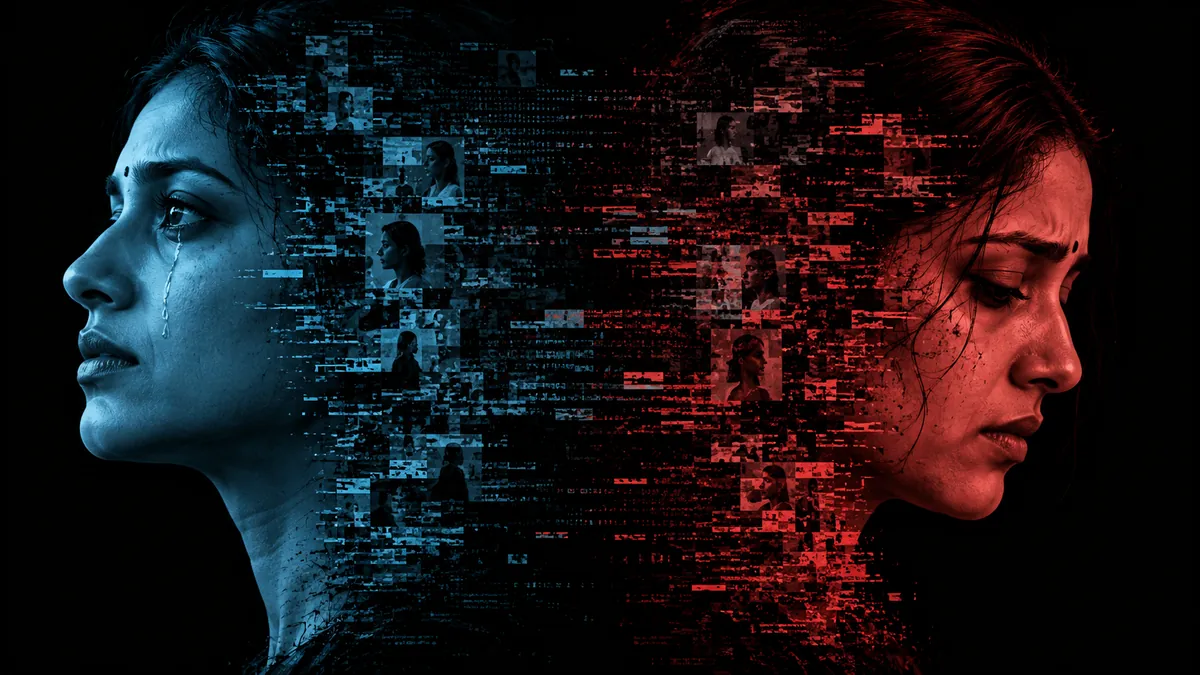
Someone took Janhvi Kapoor’s scenes from the song “Chuttamalle” in Devara, used artificial intelligence to turn them into sexually explicit footage, and released it on social media.
A woman’s dignity was violated. Her face was used without her consent. Her humiliation became something strangers could watch, request and pass around.
There can be no indulgence towards this cruelty.
I have spent more than thirty years in newspapers. Murders, sexual assaults, frauds: countless disturbing stories have passed across my desk on their way to print. Over time, you learn to work through the horror and get the story right.
But this report shook me. I felt sick. Then came the anger.
A young woman performed in a song. She did so willingly, before a camera, within boundaries she had agreed to. Someone later took that footage and manufactured a sexual depiction she had never consented to. Then they handed it to the world.
“The face was hers. The choice was stolen from her.
How have we reached a point where someone’s anguish becomes another person’s entertainment? What kind of achievement is this, to acquire extraordinary technical power and use it to degrade another human being?
A Celebrity Today. Someone in Our Classroom Tomorrow.
The manipulated footage used scenes from Devara, released in 2024. As it circulated online, Jr NTR condemned those responsible and promised legal action. Chiranjeevi, Vijay Deverakonda and Khushbu also spoke out. Janhvi herself described the violation and the pain it had caused.
It is good that the industry stood beside her. But a question keeps troubling me.
Janhvi has people with influence willing to speak for her. What happens when the victim is a college student, an office worker or a homemaker? Does her suffering matter less because nobody recognises her name? Who helps her get the images removed? Who stands beside her when the threats begin?
We have been here before. Rashmika Mandanna’s deepfake caused national outrage in November 2023. Other actresses have since faced manipulated images and videos. Each incident brings condemnation, demands for action and promises that something will change.
Then another woman is targeted.
And this abuse extends far beyond the film industry. Reports from campuses in Kerala describe students and women teachers whose photographs were manipulated. Some cases involved minors. A young woman may now find herself wondering whether someone sitting a few feet away has turned her photograph into an obscene image.
The ordinary woman we keep asking about is already there, in our children’s classrooms.
Consent Cannot Be Rewritten
Agreeing to appear in a song does not give anyone permission to manufacture sexual images from it. Being visible in public does not make a woman’s body public property. An actress does not surrender her dignity when she steps before a camera.
Yet some people dismiss the abuse with a casual remark: “But the video is fake.”
The fear is real. The distress of wondering who has seen it is real. So is the anxiety of facing friends, colleagues and relatives. So is the pain of being made to appear to have done something you never did.
India’s Supreme Court has recognised privacy as a fundamental right. That principle must mean something when technology allows a person’s identity to be appropriated and turned against them. The law must be able to recognise the violation even when the image itself is artificial.
Must She Be Someone’s Sister to Deserve Respect?
My first impulse is to ask the person responsible: “Don’t you have a mother or a sister?”
Then I stop.
Why should a woman have to be somebody’s mother, sister or daughter before we recognise her right to dignity? Is being a human being not enough?
What degree does someone need to understand that another person has feelings? That humiliation hurts? That taking pleasure in someone else’s distress is a moral failure?
My anger reaches beyond the person who created the video. It reaches those who asked for it. Those who typed “Send the link.” Those who watched eagerly and forwarded it with a laugh.
They helped the abuse travel. Each share exposes her to another audience. Even people who repost the footage to condemn it extend its reach. You can denounce the abuse without putting the victim through another public viewing.
The Machine Did Not Choose the Victim
For a moment, after reading the report, I wanted nothing to do with this technology. That was how deep the disgust ran.
Look at the ways digital tools are being misused: stalking, financial fraud, fake police threats dressed up as “digital arrests,” sexual blackmail, predatory lending and gambling that leaves families in ruin. One person wants money. Another wants sexual gratification. Someone else wants power over a frightened stranger.
Some services have made image manipulation so easy that little technical knowledge is required. A photograph from a college event or a sports day can become material for abuse in the hands of someone nursing a grudge. Once the image circulates, blackmail can follow. One act of cruelty creates an opportunity for another.

But cheap internet, smartphones and accessible AI do not make the decision to commit the crime. People do. The same tools help millions study, work, communicate and solve problems.
““AI did it” is no defence. The machine may have produced the image. A human being chose the victim and gave the instruction.
That person could have used the same ability to build a career, support a family or create something useful. Instead, they used it to attack a woman’s dignity. What did their education teach them? What did it leave out?
In the Rashmika case, police arrested a young engineering graduate from Andhra Pradesh. Reports linked the manipulation to an attempt to increase followers on a fan account. A woman’s dignity traded for attention on a screen.
The abuse is not confined to men, either. Reports about manipulated images and false allegations targeting Anupama Parameswaran described the alleged involvement of a young woman. Cruelty does not become less serious because the person behind it is also a woman.
We Have Laws. Where Is the Certainty of Justice?
India has legal provisions that can be used against this abuse. But the absence of a clearly defined offence covering the intentional creation of non-consensual sexual deepfakes makes the legal response less straightforward than it should be.
Under the Information Technology Act, Section 67 covers the electronic publication or transmission of obscene material. A first conviction carries up to three years in prison and a fine of up to ₹5 lakh. Subsequent convictions can attract up to five years and a fine of up to ₹10 lakh.
Section 67A covers material depicting sexually explicit acts or conduct. A first conviction can attract up to five years in prison and a fine of up to ₹10 lakh; subsequent convictions, up to seven years and a fine of up to ₹10 lakh. Not every image involving nudity automatically meets its requirements.
The Bharatiya Nyaya Sanhita also contains provisions that may be relevant, depending on the facts. Section 78 addresses stalking, including specified forms of monitoring a woman’s electronic communications. Section 79 addresses acts intended to insult a woman’s modesty or intrude upon her privacy. Section 356 deals with defamation.
Voyeurism under Section 77 presents another distinction. Secretly recording a woman engaged in a private act is different from manufacturing an entirely fictitious sexual depiction out of publicly released footage.
That is why the law needs greater precision. Creation, commissioning, publication, sexual blackmail and commercial exploitation should be clearly addressed. The law should leave no room for someone to claim that a woman’s suffering falls between definitions.
India has also strengthened the responsibilities of online platforms. Under the amended IT Rules, complaints concerning specified intimate material and impersonation, including artificially morphed images, require platforms to remove or disable access within two hours. AI services covered by the rules also have duties to deploy technical measures against prohibited synthetic content.
Those are serious obligations. Are they being met? How many complaints receive action within the required time? How often does the same material reappear? The government and the companies owe the public answers.
A Severe Sentence Means Little if Nobody Expects to Be Caught
I want strong punishment for these offences. But severity on paper is only part of the answer. The person contemplating this abuse must believe that investigators will find them, evidence will survive and a proven offence will bring consequences.
“An offender who expects to escape is not frightened by a maximum sentence printed in a statute.
Police action in high-profile cases shows that digital trails can be followed. Payments, account activity and devices can provide evidence. Foreign servers and false accounts can complicate a case, but they should not become excuses for abandoning it. The same determination must be available to an ordinary student who walks into a police station.
Other Countries Have Begun to Act
India does not have to invent every response from scratch:
● South Korea: Possessing, purchasing, storing or viewing sexual deepfakes is now a crime, alongside producing and distributing them.
● England and Wales: Since February 2026, creating an intimate deepfake of an adult without consent is itself an offence, as is asking someone else to create one. The law does not wait for publication.
● United States: The TAKE IT DOWN Act, enacted in May 2025, covers non-consensual intimate images including digital forgeries. Platforms must remove them within 48 hours of a valid request.
Australia and the European Union have moved in the same direction. None of these measures has eliminated the problem. But together they show what a serious response looks like. India should adapt them to its own legal system, strengthen what is missing and enforce what already exists.
Follow the Business Behind the Abuse
Downloadable AI models present a harder problem. A model copied onto someone’s computer may run offline, with its safeguards altered. Once copies are widely distributed, there is no switch that shuts them all down.
That difficulty cannot become an excuse for surrender. After a lifetime around printing presses, I see a familiar principle. Nobody banned the printing press. But the man who printed and distributed obscene pamphlets was caught, because printing can happen in secret while distribution must happen in the open.
Abusive services rely on an online business: hosting, promotion, customers and payments. Those connections are where lawful intervention can work. App stores, advertisers and payment providers should not knowingly serve them. Platforms should block identified material from being re-uploaded, without destroying the evidence investigators need. And companies cannot settle every question about their responsibility by saying, “We only supplied the tool.”
My Demands Are Clear
The Centre has said it will bring a new law with clear penalties for deepfakes. Announcements are no longer enough. That law must come in the next session of Parliament, and it must include at least the following:
● Creating, commissioning, publishing, using for blackmail and profiting from non-consensual sexual deepfakes must each be a specific offence, with strong punishment.
● It should be a non-bailable offence. Not a notice. An arrest.
● Where the victim is a child, or where the humiliation drives her to take her own life, the punishment must be harsher still.
● Those who knowingly keep, request or forward such material should also face prosecution, with clear protection for legitimate reporting and investigation.
● These cases should be decided by fast-track courts within six months. Every district needs digital forensic support capable of examining deepfakes.
● Every school, college and workplace needs a clear procedure for the first 48 hours: whom to contact, how to protect the person targeted and how to preserve evidence without circulating the material or tampering with devices.
● Victims need free legal aid, counselling and compensation. Their identities must never be made public.
● Every quarter, the public should see the figures: complaints received, material removed within two hours, arrests, prosecutions and convictions.
“We will take strict action” has become a sentence people hear too often. Show us the action. It should make no difference whose child the offender is, how much money they have or which political party they support.
“Influence must not buy immunity. When an offender escapes accountability, others see permission.
The Audience Has Responsibilities Too
The creator bears responsibility for the abuse. The audience can help it spread.
Do not ask for the link. Do not forward the material. Do not turn someone’s violation into gossip. Do not blame the woman’s clothes, her profession or the role she played. The shame belongs to the person who abused her identity.
Report it to the platform, call the cyber helpline 1930, or file a complaint at cybercrime.gov.in. Preserve links, account details and dates securely, without circulating copies. When contacting a platform, refer to Rule 3(2)(b) of the IT Rules.
Parents need to teach responsibility along with digital skills. A girl on a screen is a person, not material for somebody’s experiment.
To anyone targeted by this abuse: you did nothing to deserve it. You should not have to confront the offender alone. Paying a blackmailer offers no guarantee that the threats will stop. Secure your accounts. StopNCII.org (for adults) and Take It Down (for images taken when the person was under 18) can help limit circulation on participating platforms.
Schools and colleges should also review how they publish students’ photographs. Protecting access is a sensible precaution. It must never become a reason to blame someone whose picture was misused.
What Kind of Progress Are We Making?
At times, I find myself longing for life fifty years ago. I know there was injustice then. I know many people suffered in silence.
But I miss the idea of a life in which affection, restraint and respect had more room. A life before someone’s humiliation could be delivered to thousands of strangers in seconds and converted into attention or income. I do not want to give up every modern convenience. I want us to recover the habit of treating another person as a human being.
Our phones have become smarter. Has our conduct become more humane?
From the Ramayana and the Mahabharata, we have inherited warnings about the consequences of humiliating women. We repeat those stories. Yet we still struggle to practise the respect we claim to believe in.
We have acquired the power to rewrite a face, manufacture a voice and invent an event. Where is the restraint to leave another person’s dignity intact?
There can be no tolerance for this abuse. The material must be removed. Victims must be protected. Those responsible must be investigated, prosecuted and, when guilt is proved, punished.
A woman should never have to pay for somebody else’s cruelty with her peace of mind.
We cannot wait for the next victim.