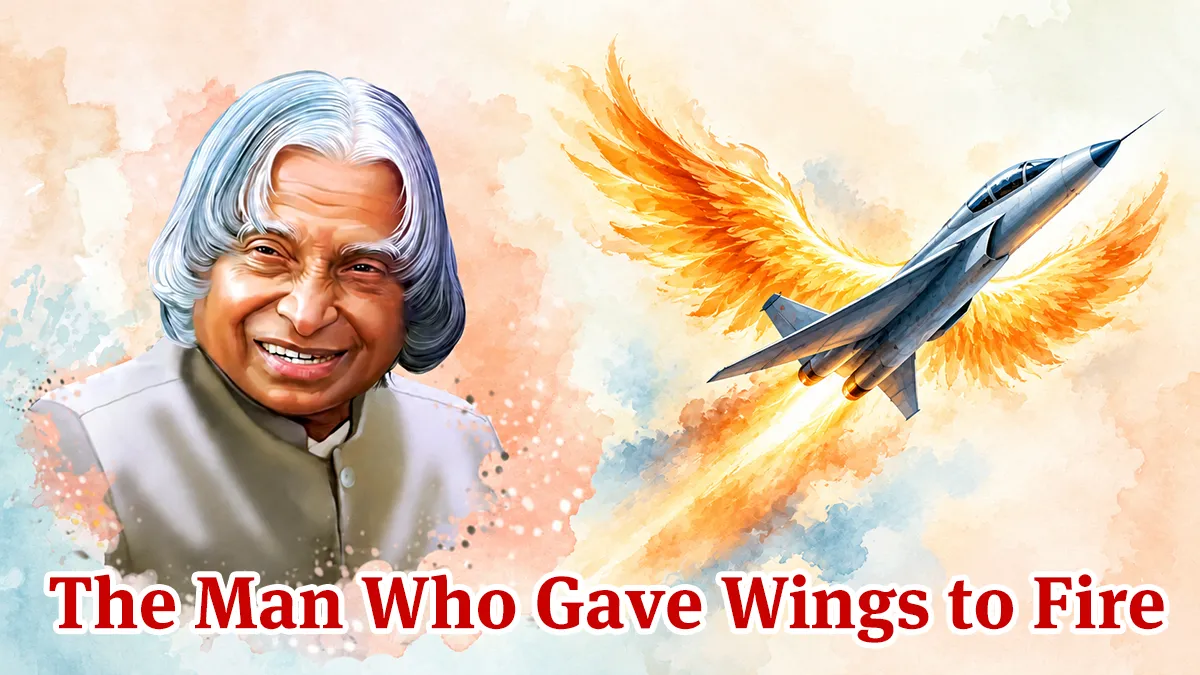
APJ Abdul Kalam (1931–2015) · AI illustration
- Ninth place at the pilot selection, and the journey that began there
- A crashed rocket, and a warm hand on the shoulder
- Missiles in Hyderabad, and a stent for the poor
- At 74, in the cockpit of a Sukhoi
On Kalam’s birth anniversary, a letter to every young person who has been told “not this time”
Eight candidates were to be selected. He came ninth.
At the Air Force selection board in Dehradun, a young engineer read the results and felt his world go still. He had wanted to fly since he was a boy. Now the dream had slipped away by a single place.
That young man was Abdul Kalam. Today, October 15, marks his 95th birth anniversary, a day India also observes as Students’ Day.
We remember Kalam as the Missile Man, the Bharat Ratna, the People’s President. A life of victories, it seems. But read his autobiography, Wings of Fire, and a different man emerges. A man who failed again and again, and who got back up every single time. That is the Kalam today’s young people need to meet.
Setback 1: Three Days
He was a student of aeronautical engineering at the Madras Institute of Technology, leading his team on an aircraft design project. The work fell behind schedule. The director, Prof. Srinivasan, reviewed the design and was unimpressed. Finish it in three days, he said, or your scholarship is gone. For a boy from a poor family, losing the scholarship meant losing his education.
Kalam worked through those three days with barely any food or sleep. He finished before the deadline. Only then did the professor reveal what he had been doing all along: he had put Kalam under pressure deliberately, to see what he was capable of.
Pressure doesn’t always arrive to break us. Sometimes it comes to show us what we’re made of.
Setback 2: Ninth Place
Then came Dehradun. Kalam didn’t go straight home after the results. He travelled to Rishikesh, bathed in the Ganga, and went to see Swami Sivananda. He poured out his disappointment. The Swami’s advice, in essence: accept what has happened and move on. You were not meant to be a pilot. Something else is waiting for you.
Kalam returned and joined the Defence Ministry as a Senior Scientific Assistant, on a salary of ₹250 a month.
Setback 3: The Hovercraft That Never Went Anywhere
At the Aeronautical Development Establishment in Bangalore, Kalam was handed a big responsibility: build an indigenous hovercraft. His team delivered. They called it Nandi. Defence Minister V.K. Krishna Menon even took a ride in it himself. But once Menon left office, the project was shelved. Months of hard work, quietly put away.
Yet that disappointment opened a door. A call came for an interview with Dr. Vikram Sarabhai, and Kalam stepped into space research. The hovercraft that went nowhere had pointed him towards rockets.
Setback 4: A Rocket in the Sea

August 10, 1979. Sriharikota. The launch of SLV-3, India’s first satellite launch vehicle. Years of effort, the hopes of hundreds of scientists, and Kalam as project director. The rocket lifted off. Then its second stage lost control, and within minutes it plunged into the Bay of Bengal.
Exhausted and crushed, Kalam went back to his room and fell asleep. That was when Dr. Brahm Prakash, director of the Vikram Sarabhai Space Centre, came to his room and took him out for a meal. The gesture said more than any words of comfort could: you are not alone in this.
At the press conference, ISRO Chairman Prof. Satish Dhawan stepped forward and took responsibility for the failure himself. He didn’t let a single finger point at Kalam.
Almost exactly a year later, on July 18, 1980, SLV-3 placed the Rohini satellite in orbit. This time Dhawan stepped back and sent Kalam out to announce the success to the world.
“A leader carries the failure and shares the success.
And a person who has just failed needs more than a post-mortem of their mistakes. They need a warm hand on their shoulder. That day, Kalam got both.
The Hyderabad Decade

It was on this foundation of setbacks that Kalam’s real journey began. In 1982 he became director of the Defence Research and Development Laboratory (DRDL) in Hyderabad, the hub of India’s integrated missile programme. Prithvi was first test-fired in 1988, Agni in 1989. Hyderabad is where he earned the name “Missile Man”, and for nearly a decade, he was one of us.
He also turned the know-how built for missiles towards saving lives. Working with Hyderabad cardiologist Dr. B. Soma Raju, he helped develop the low-cost “Kalam-Raju stent”, a lifeline for patients who could never afford expensive imported ones. The same hands that built missiles also thought about the hearts of ordinary people.
The Day He Got the Sky
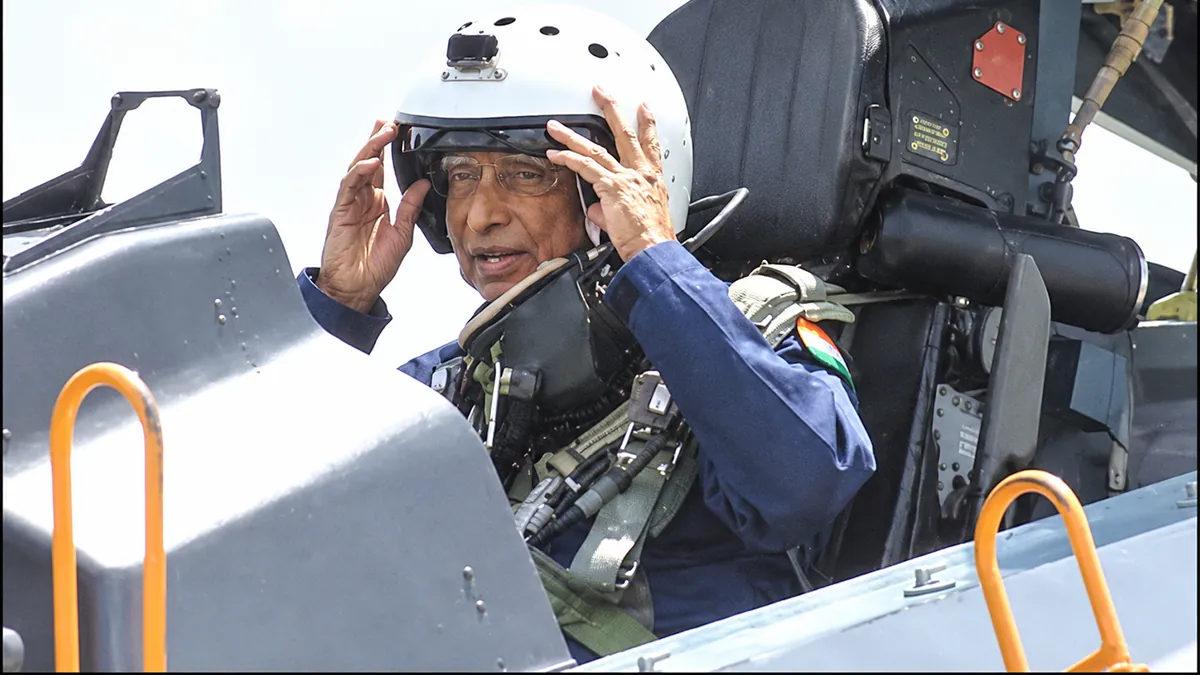
Now, back to where we started.
June 2006. Lohegaon Air Force Station, Pune. A 74-year-old man pulled on a G-suit and climbed into the cockpit of a Sukhoi-30 fighter jet. He spent about half an hour in the skies. That man was the President of India, Abdul Kalam.
Nearly fifty years earlier, the Air Force had turned him away as a pilot. On that day, he flew not just any plane, but one of its most advanced fighters.
“Ninth place never took the sky away from him. It only postponed it.
To the Young Who Have Stopped at a Setback
The pressure on young people today is no small thing. Miss a rank in an exam, fall short in a job interview, and it can feel as if life itself is over. Scrolling through other people’s successes on social media, many start to think less of their own journey.
To every one of them, and to all of us around them, Kalam’s life offers three lessons.
A setback is a turn, not a verdict. Ninth place, the shelved hovercraft, the crashed rocket. Each one redirected him. None of them stopped him.
Don’t hide your pain, and stand by those who are hurting. Kalam went to Rishikesh and spoke about his disappointment. On the day the rocket fell, Brahm Prakash came to his door. The parent who sits beside a child who failed an exam, the friend who listens to someone who has lost a job, the leader who puts a colleague back to work after a mistake: that support is what gives a person the strength to try again.
Never stop learning. Whether or not your name makes the list, what you have learnt stays with you. It is what brings the next opportunity to your door.
On July 27, 2015, Kalam collapsed while delivering a lecture to students in Shillong. He was among young people until his very last moment. The best tribute we can offer him is simple: sit beside one young person who is struggling with a setback and tell them this story. And if you can, put a copy of Wings of Fire in their hands.
The idea behind that book’s title lives in two lines Kalam wrote:
“We are all born with a divine fire in us. Our efforts should be to give wings to this fire…”
The selection list ended at eight. Kalam’s story began right there.
Our own stories still have pages waiting to be written.