A Review of Reviews
Applause for the spectacle, a split over story and character. What do the major reviews say when you read them side by side?
We all know how the Ramayana ends. The ancient Sanskrit epic attributed to the poet Valmiki, the story of Prince Rama, his exile, the abduction of his wife Sita by the demon king Ravana and the war to bring her home, has been told in India for well over two thousand years. And yet every time Rama walks onto a screen, something in us leans forward. How will Sita look? What will Ayodhya feel like? Will the exile still break our hearts? Will Ravana carry the menace he should? Even a story we have known since childhood comes with its own questions.
With the first part of Nitesh Tiwari’s Ramayana, starring Ranbir Kapoor, Sai Pallavi and Yash, now in theatres, that anticipation has turned into argument. Did the enormous effort behind the film pay off on screen? Amid all the technical grandeur, does the emotion of the epic still land? The reviews do not agree, and perhaps they never could.
Some critics have hailed the film as a magnificent visual experience. Others feel the storytelling drags and the emotions needed more weight. This piece brings those voices together in one place: Maro Maata’s review of reviews.
This is not Maro Maata’s own review of the film. It is a reading of published reviews.
| Detail | Information |
|---|---|
| Film | Ramayana: Part 1 |
| Cast | Ranbir Kapoor, Yash, Sai Pallavi, Sunny Deol, Kajal Aggarwal, Shobana, Arun Govil, Ravie Dubey, Lara Dutta and others |
| Director | Nitesh Tiwari |
| Producers | Namit Malhotra, Yash |
| Production companies | Prime Focus Studios, DNEG, Monster Mind Creations |
| Music | Hans Zimmer, A. R. Rahman |
| Runtime | 3 hours 15 minutes |
| Languages | Hindi, Telugu, Tamil, Kannada, Malayalam, English |
| Release | 5 November 2026 |
Credit for the craft on screen
If there is one thing the reviews keep returning to, it is the spectacle. The effort to build the world of the epic on screen, the battles and the visual effects drew warm words from many critics.
Eenadu, the largest Telugu-language daily, counted the visuals, the cast and the action among the film’s strengths, while noting that the narrative slows in places. It saw the film as a visual epic shaped to reach today’s audiences.
Trinethra News, a Telugu news site, praised the technical craft in set pieces such as the battle with the great bird Jatayu and the flying chariot Pushpaka Vimana, though it felt the graphics were weak in a few places.
Abroad, Peter Bradshaw of The Guardian gave it four stars out of five, calling it a thoroughly engaging and rousing epic. He found something Shakespearean in the way royals submit to exile in the forest with stoic grace, and saw in a prince vowing war on a distant city to rescue his abducted wife a story that might satisfy anyone missing Homer. With its vast canvas and its sunset skies, the film reminded him of Peter Jackson’s Lord of the Rings and even Disney’s The Lion King, and he enjoyed Ravana’s strange flying machine. Like so much Indian cinema, he wrote, it recalls the forthright storytelling energy of Hollywood’s sword-and-sandal era of the 1950s and 1960s. His verdict: a rather amazing adventure.
Read together, these responses suggest the work of the people behind the screen did not go unnoticed. Where critics part ways is on how much that work strengthened the story itself.
The real test: telling a story everyone knows
In a story like the Ramayana, the audience always knows what comes next. The moment still has to move them. We know Rama will go into exile, yet watching a son leave his father should still hurt. We know Sita will be taken, yet that moment should still grip us.
That familiarity is both the director’s opportunity and his burden.
Several critics pointed out how hard it is to make a known story feel fresh, and felt the film runs long as the tale is stretched across two parts. Sakshi, another major Telugu daily, also flagged the drawn-out stretches as a weakness.
This is where the reviews divide most clearly. Some were swept away by the grandeur of the images; others cared more about the emotional pull and the pace of the story.
Ravana at the heart of Rama’s story
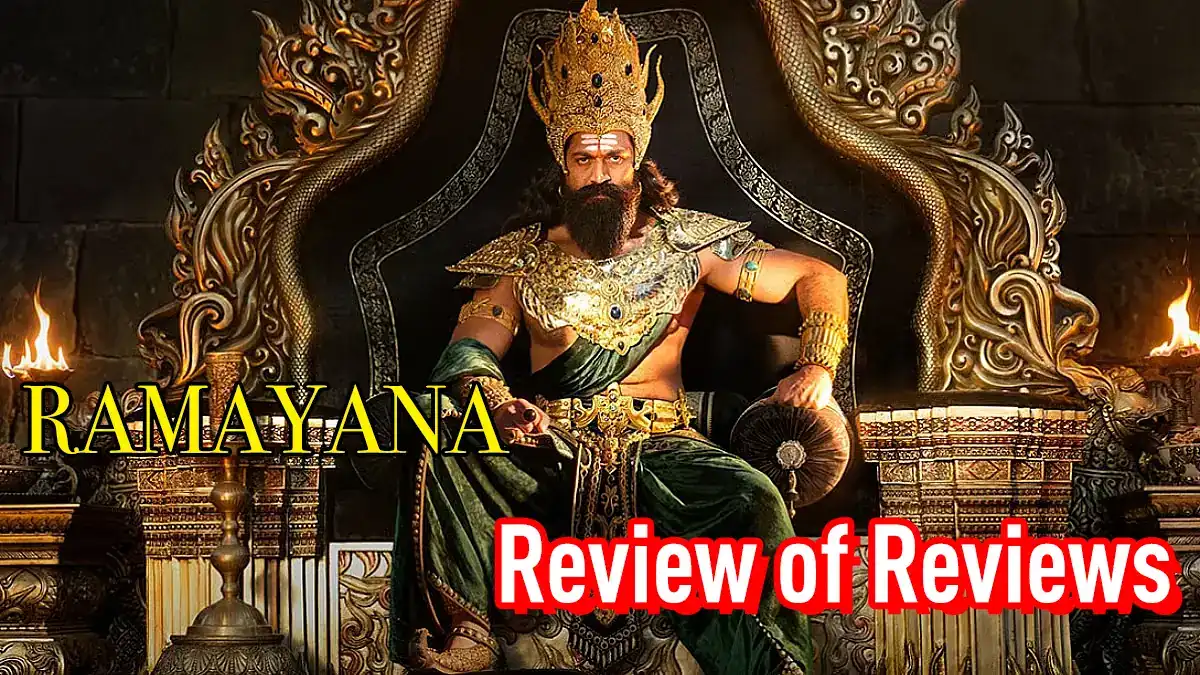
The most interesting thread running through these reviews is Yash’s Ravana, the ten-headed king of Lanka who is the epic’s antagonist.
Sakshi named Yash as one of the film’s main attractions. Trinethra felt his presence dominates the first part, and praised both his look and his delivery.
The Hollywood Reporter India took the debate further. In the tug of war between devotion and storytelling, it argued, Yash leads. The film plays it safe, careful not to offend, and the cheers in the hall come less from the filmmaking than from the memories of the Ramayana we already carry. Ravana’s backstory is told so compellingly that it almost rewrites the epic’s DNA, and the film’s best stretches revolve around him. Ranbir Kapoor’s Rama, by contrast, felt stiff under the pressure of having to seem flawless. The review found the first half rushed, and the second half, which opens with the exile, much tighter.
BBC News Telugu also highlighted that the story is framed from Ravana’s side, and went further: showing Ravana with no desire for Sita, abducting her purely to avenge himself on Rama, is a reading that contradicts Valmiki’s original. Samayam Telugu, the Telugu site of the Times group, saw it the opposite way, praising the film for taking cinematic liberties while treating Valmiki’s text with great respect. That two Telugu reviews could reach such opposite verdicts on the same film is telling in itself.
It raises a natural question. Did giving Ravana more room add new depth to the story, or did it draw attention away from Rama’s own journey? The answer may depend on what each viewer walks in expecting.
Performances and music: no common ground
Sakshi and Trinethra both felt Ranbir Kapoor looks the part of Rama. Sakshi, though, wished the Telugu dubbing had been a better fit. Neither review heaped praise on Sai Pallavi’s Sita, but BBC News Telugu found her performance memorable, and NTV, a leading Telugu news channel, said she won viewers over.
On the music, the split is even sharper. Sakshi praised the background score but found the songs weak. Trinethra was unhappy with both the songs and the score.
The same scene, the same melody, landed differently with different people. That is the value of reading reviews side by side: you begin to see the taste behind one verdict and the expectations behind another.
What audiences are saying
Critics are one voice; the first-day audience is another. Several social-media reactions highlighted Jatayu’s battle with Ravana. Jatayu, the vulture king, tries to stop Ravana as he carries Sita away. The moment the old bird falls, his wing severed, left many viewers emotional, and those who saw it in IMAX wrote that it left them stunned.
Know what went into that one sequence and the reaction makes sense. Director Nitesh Tiwari recently revealed that the Jatayu–Ravana battle alone took six and a half years and the work of thousands of technicians. Maro Maata has written in detail about the people behind the screen.
Audiences are not of one mind either. Plenty of viewers felt the spectacle won out while drama and emotion fell behind. The divide among critics runs right through the audience too.
Who rated it what?
The ratings below are taken directly from each source. Where a review gave no star rating, we have not invented one.
| Outlet | Rating |
|---|---|
| DNA | 4.5/5 |
| The Guardian | 4/5 |
| Sakshi (Telugu daily) | 3/5 |
| Samayam Telugu | 3/5 |
| NTV Telugu (news channel) | 3/5 |
| Chitrajyothy (film site of the Andhra Jyothy daily) | 2.5/5 |
| Eenadu | No star rating |
| TV9 Telugu | No star rating |
| BBC News Telugu | No star rating |
| Trinethra News | No star rating |
| The Hollywood Reporter India | No star rating |
Average of the ratings above
| Group | Outlets with a rating | Average |
|---|---|---|
| Telugu outlets in the table | 4 | 2.88/5 |
| All outlets in the table, Telugu and English | 6 | 3.33/5 |
Each outlet’s rating is weighted equally. Reviews without a star rating are left out. This is the average of the reviews listed here only, not a verdict from all media or from audiences.
Where Rotten Tomatoes stands
This is what Rotten Tomatoes showed when we checked at 8:53 p.m. IST on 5 November 2026:
| Measure | Score | Count |
|---|---|---|
| Critics — Tomatometer | 50% | 14 reviews |
| Audiences — Popcornmeter | Not yet published | Rating count not confirmed |
A score of 50% does not mean the film got 50 out of 100. It is the share of critics’ reviews that Rotten Tomatoes classes as positive. We have not converted it into stars or added it to the average above, and it will change as more reviews come in.
Maro Maata’s view
This is no ordinary film. It is a 21st-century screen version of an epic that belongs to all of India. To weigh it only by the yardsticks we use for any other film, its length, its pace, is to miss what it is attempting. An epic told in detail will take its time.
Telugu audiences have seen the Ramayana on screen many times: from N. T. Rama Rao’s Lava Kusa in 1963, through Bapu’s Sampoorna Ramayanam in 1971, to Sri Rama Rajyam in 2011. The filmmakers of that era approached the story through devotion. Today’s director tells the same story partly through Ravana’s eyes, and with the tools of modern visual effects. That shift is what makes this film so interesting.
Critics disagree on how faithfully the film interprets the epic. Some praise its respect for the source, while others question particular departures from Valmiki. The six rated reviews listed here average 3.33 out of 5; that figure describes this selection, not a consensus among all critics.
Criticism deserves a hearing, but it should not have the final word. Go to the theatre. See it with your own eyes. Measure this epic with your own heart.
So what do all these reviews tell us?
The spectacle of Ramayana has become the centre of the conversation, and Yash’s Ravana has impressed many critics. On the pace of the story, the strength of its emotions and its music, there is no consensus.
One contrast is particularly striking. Several Telugu reviews discuss Ravana’s point of view and fidelity to Valmiki, while British critic Peter Bradshaw draws comparisons with Shakespeare and Homer. These responses show how critics can bring different frames of reference to the same film.
Recognising the labour behind a film is one thing. Asking how deeply that labour reaches the viewer’s heart is another. The reviews weighed these two things very differently.
That is why a star rating tells you something about a film, and the reasons behind those stars tell you a great deal more.
In the end, the test of a film like this is not only how vast a world it builds on screen. It is how close Rama, Sita and Lakshmana feel to us within that world. Amid all these differing verdicts, that remains the question that matters most.