The people, preparation and patient work behind a new screen adaptation of a timeless story
One shot. Around fifty rehearsals.
A camera moves swiftly on a tall crane. During the movement, a camera operator must run towards it, detach the stabilising device that holds the camera, and carry it in a circular movement towards the actor.
The timing has to be precise. The crane, the operator, the camera and the actor must all arrive where they are meant to be.
Cinematographer Pankaj Kumar described this demanding shot while discussing the making of Ramayana. It took around fifty rehearsals to achieve the movement planned in advance. Those were rehearsals to prepare the shot, rather than fifty failed attempts during filming. Pankaj Kumar’s interview with Variety India.
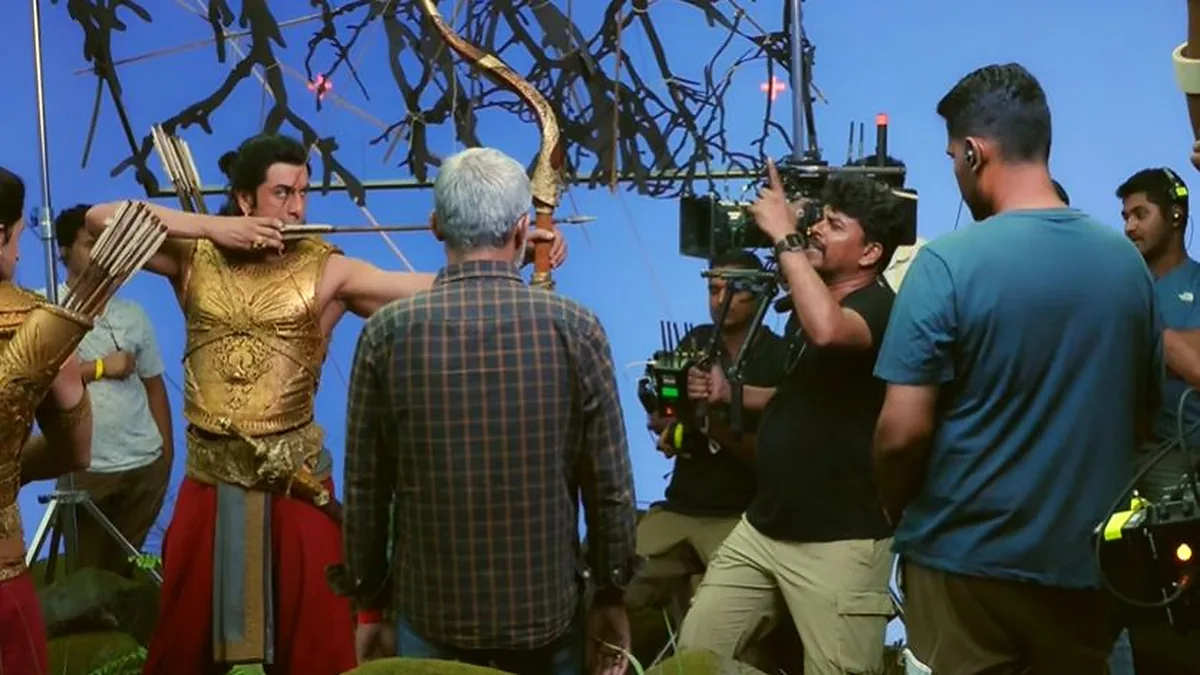
When we watch the finished scene, we may notice none of this. Our attention will be on the actor. If the shot works, we will simply follow the story.
Behind that effortless viewing experience is a group of people working hard to make it possible.
That is where this making-of story begins.
▶ See how it was made: Ramayana behind-the-scenes video (YouTube)
The Rama we bring into the theatre
For many of us, Ramayana comes with memories.
A grandmother telling a story. A performance in the village. A picture of Rama’s coronation on the wall at home. The family gathering around the television. N. T. Rama Rao appearing as Lord Rama on the cinema screen.
We discover the epic in different ways. Over time, its people and places become familiar. We carry those memories into every new adaptation.
A filmmaker taking on Ramayana must understand that attachment. The film must also welcome viewers who have never heard the story.
That is the ambition behind Nitesh Tiwari’s two-part Ramayana.
Producer Namit Malhotra has spoken about bringing generations together: older viewers who know the epic and children growing up with Western superheroes. He wants a new generation to understand why Rama is loved and revered. The New Indian Express interview.
To introduce Rama to the world, a film must help us understand his choices.
Why did he leave a kingdom behind? Why did a promise matter so deeply? How did he carry his responsibilities through personal suffering?
The answers must reach the audience through the story. That is how a familiar name becomes someone a viewer cares about.
The director’s responsibility
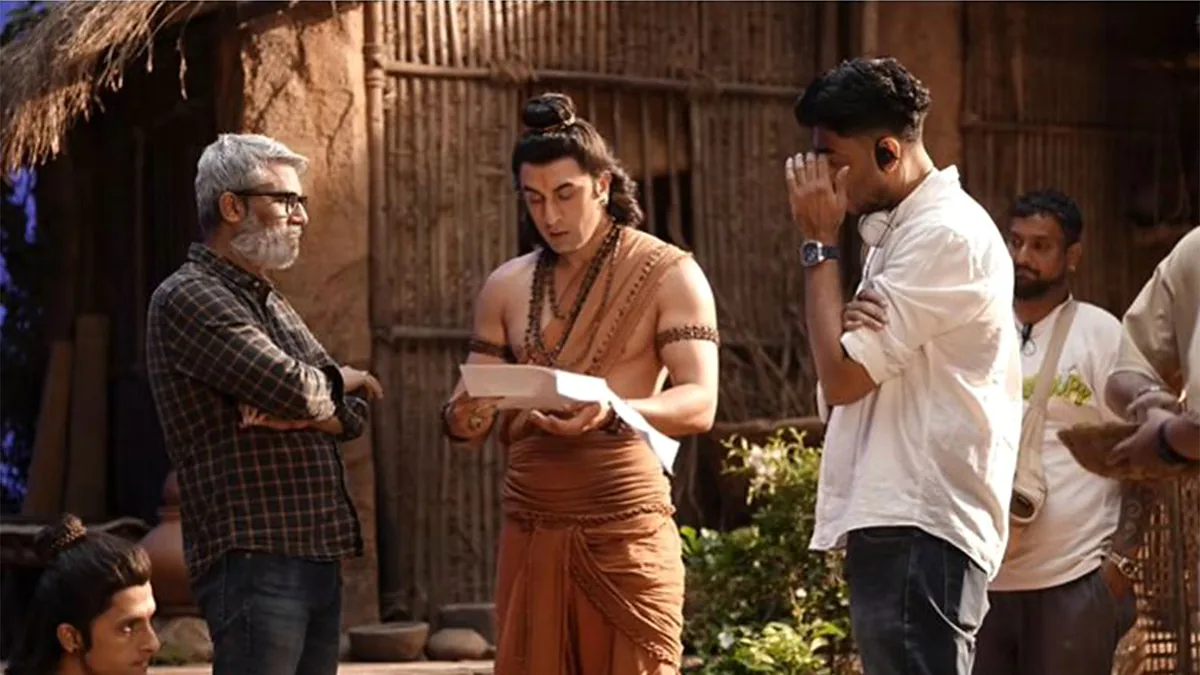
A palace can impress us. A battle can excite us. Making us feel a character’s pain takes a different kind of care.
When should a character speak? When should the camera stay with a silent face? How long should a moment last? When should the music begin?
These decisions shape our experience of a film.
Tiwari has described Rama’s journey in terms of choices, consequences and the burden of doing what is right. His stated aim is to preserve its emotional richness and humanity. Prime Focus Studios’ announcement.
That understanding must travel through the production. The actor needs it. The cinematographer needs it. So do the composers, designers and editors.
Their work must come together around the same emotional purpose.
The film begins on the page

The official credits name Shridhar Raghavan and Nitesh Tiwari as the screenplay writers, with Valmiki’s Ramayana as the source. Namit Malhotra and Yash are credited as producers. Sony Pictures’ credits.
A screenplay gives a story its sequence of scenes. It decides what we see, when we see it and how one moment leads to the next.
For an epic as vast as Ramayana, those choices matter enormously.
How much time should an episode receive? Where should a relationship be established? What must the audience understand before a separation can hurt?
The writers have to give the story room to breathe within the limits of two films.
Long before a set is built, this work begins on the page.
Finding the people behind the characters
The announced principal cast includes Ranbir Kapoor as Rama, Sai Pallavi as Sita, Yash as Ravana, Sunny Deol as Hanuman and Ravie Dubey as Lakshmana. DNEG’s announcement.
Mukesh Chhabra worked on casting the film. Outlook’s interview with Chhabra.
Casting requires an understanding of how an actor can inhabit a role. Appearance matters, but so do movement, speech, emotional range and the ability to build convincing relationships with other performers.
Tiwari has explained that he saw Rama as someone who does not readily reveal his grief. He wanted an actor who could communicate that inner life with restraint. Tiwari on choosing Kapoor.
The audience must sense what the character is carrying, even when he says very little.
That is a demanding task for a performer.
Six months for a wedding outfit
Costume designers Rimple and Harpreet Narula have worked on the film’s wardrobe.
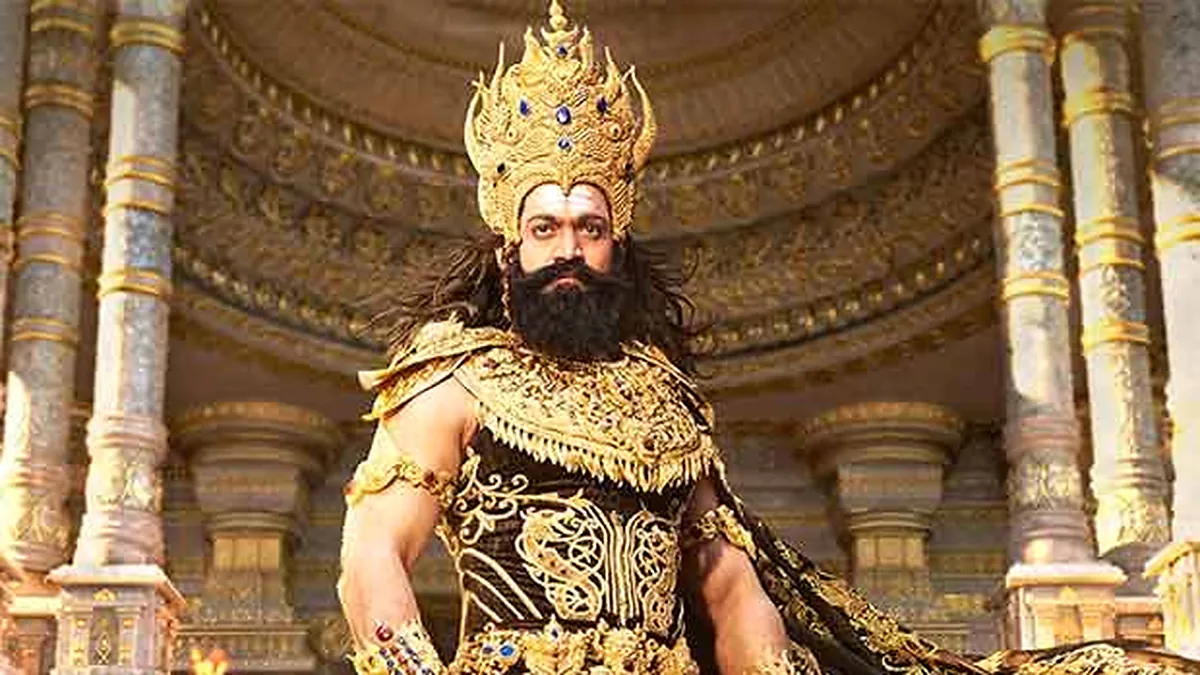
In an interview, Rimple said the project involved more than 500 costumes. Around 30 to 40 outfits were made for Rama in Part One, with duplicates also needed for filming.
Sita’s wedding outfit took about six months to create. Rimple Narula’s interview with Rediff.
Six months for an outfit we may take in at a glance.
Fabric has to be chosen. Colours have to be settled. Designs must be drawn, stitched, embellished and fitted. The result must suit the character and allow the performer to move.
Many hands turn a designer’s drawing into something an actor can wear.
Rimple described choosing colours that would express Rama’s calmness. His exile clothing was made to look worn and lived in. She also spoke about handloom fabrics and visiting weavers in Banaras. Details of the costume work.
On screen, we will see Sita in her wedding attire. The people who helped make it will be out of sight.
Their work will still be there.
The hands that build a kingdom

Ravi Bansal and Ramsey Avery were announced as the film’s production designers—the specialists responsible for shaping its physical and visual world. Official team announcement.
Ayodhya, Mithila and Lanka already exist in our imagination. A film must give them a definite form.
What should their buildings look like? How large should a doorway be? Which colours and objects belong in each place?
Drawings become plans. Plans become structures. People measure, build, paint and arrange. Digital artists extend the world where required.
The audience sees a city. Beyond the frame are the hands that helped put it there.
Planning the scene before filming it
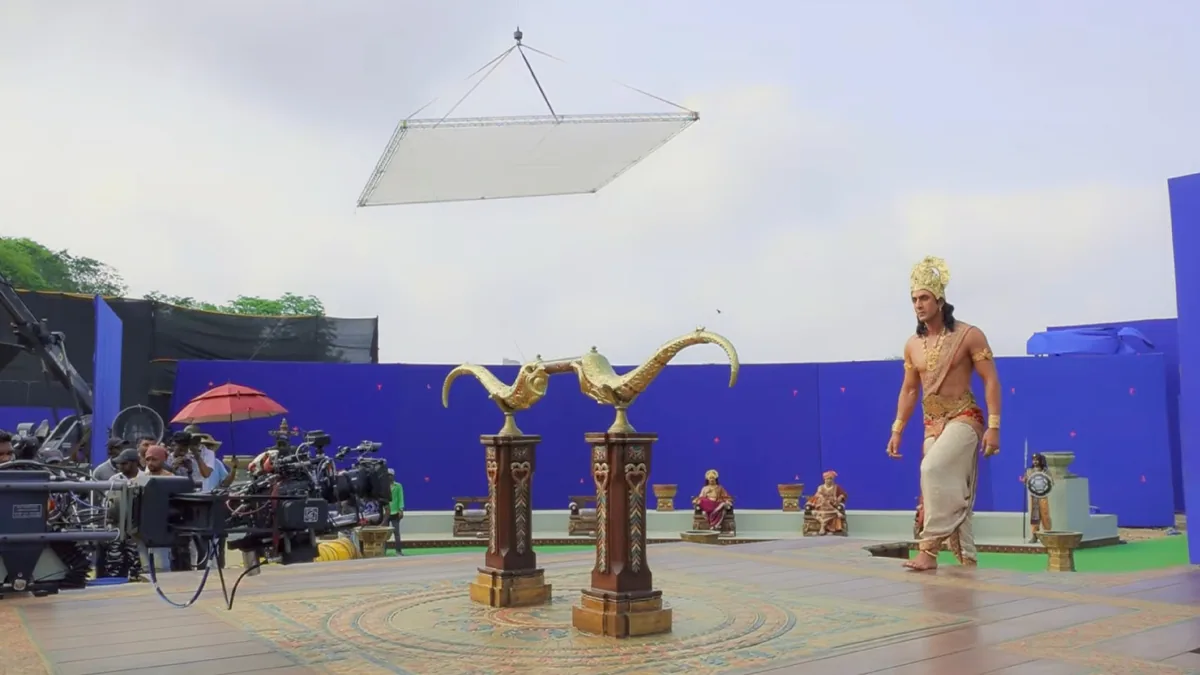
Pankaj Kumar has described the extensive preparation behind Ramayana.
Shots were first developed as moving scenes in a computer-generated environment. The team could examine where a character would stand, how the camera would move and what would appear behind the performers.
This process is called previsualisation.
Kumar worked with animators and discussed the shots with Tiwari. It helped the departments understand what they needed to prepare: which part of a set to build, which background to create digitally and where the light should come from.
He said he had never done this much pre-production on another film. Variety India’s interview on previsualisation.
A scene planned on a computer must eventually be performed and photographed. People and equipment have to reproduce those movements together.
The shot that needed fifty rehearsals gives us a glimpse of that challenge.
The crew behind the camera

Pankaj Kumar and Mahesh Limaye are credited with cinematography. Official credits.
Their task includes capturing both the scale of the world and the feeling within a scene.
The camera may reveal a vast palace, then move close enough to catch a slight change in someone’s expression. Light, framing and movement help us understand both.
Camera operators, assistants, lighting crews and the people handling camera-support equipment make those choices possible.
A shot can only happen when their work comes together.
The preparation behind a battle
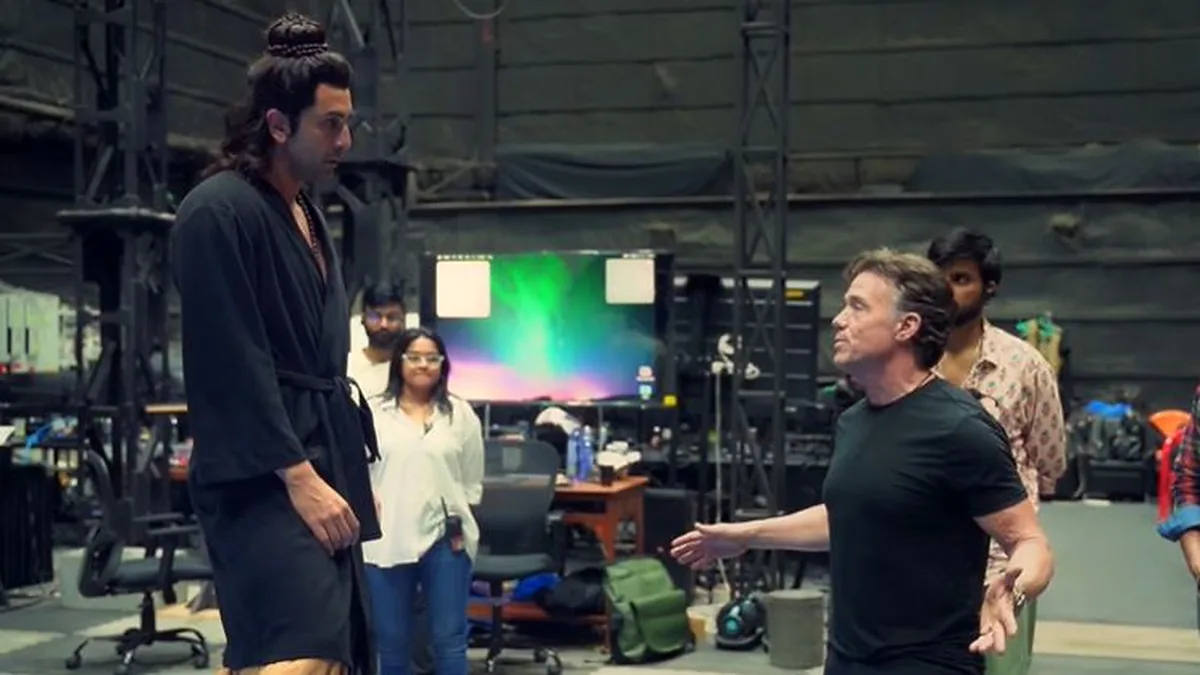
Terry Notary and Guy Norris were announced as the action choreographers. DNEG’s announcement.
An action scene needs careful planning. Performers must know where to move and when to stop. The camera must be in position. Safety arrangements must be ready.
Actors and stunt performers rehearse those movements so that the action feels convincing.
What rushes past us on screen may have taken patient preparation. We may never know every stunt performer’s name, but their skill contributes to what we believe.
The people inside the visual effects

DNEG and ReDefine are providing the film’s visual effects. Official announcement. DNEG, whose work on films such as Inception, Interstellar and Dune has won Oscars, is led by Namit Malhotra—the same man producing this film.
Visual effects help complete the world a scene needs. A constructed section of a set can become part of a much larger city. Creatures can be created digitally. Water, fire and smoke can be added or extended.
Every element must belong in the same frame.
An actor’s eyeline must match the position of a digital character. Shadows must fall correctly. Movement must suggest weight. The light must agree with the photographed scene.
Actors may have to respond to something that will only be added later.
Behind the computers are artists making those decisions: shaping forms, adjusting movement, refining light and combining images.
Their work helps the audience accept the world and stay with the story.
Words, music and silence
A. R. Rahman and Hans Zimmer are credited with music, while Huzefa Lokhandwala is credited as editor. Sony Pictures’ credits.
Editing turns filmed material into a flowing story.
How long should we stay with a face? Whose reaction should follow a line? Where should the pace quicken? Where should the film pause?
Music, dialogue and surrounding sounds carry that experience further. Sometimes silence gives a moment the space it needs.
Composers, musicians, singers, recording teams, dialogue editors and sound mixers all contribute.
Their work can remain with us long after the image has gone.
Eleven teams and an enormous undertaking
Malhotra has said that 11 teams around the world were working on Ramayana. The producer’s interview. The makers have said that more than 10,000 people worked across those teams. The makers’ statement on crew size.
He has also put the anticipated expenditure across both films at about US$500 million, widely reported as more than ₹4,000 crore. Reporting on Yash’s explanation says the figure includes promotional spending. It remains a stated estimate rather than an audited final account. The Indian Express on the budget.
Prime Focus Studios, DNEG and Yash’s Monster Mind Creations are involved in the production. Production announcement.
An undertaking of this size needs daily organisation.
Costumes must arrive on time. Sets must be ready. Cameras and lights must be prepared. People need transport, meals and safe working arrangements.
One department depends on another. Much of the work that keeps filming possible happens far from the spotlight.
The people behind the numbers
| Work | Publicly stated figure |
|---|---|
| Films | Two parts |
| Teams worldwide | 11, according to the producer |
| People involved | More than 10,000, according to the makers |
| Estimated expenditure across both films | About US$500 million; reported as over ₹4,000 crore, including promotion |
| Costume work | More than 500 costumes, according to Rimple Narula |
| Rama’s outfits for Part One | Around 30–40, with duplicates also required |
| Sita’s wedding outfit | About six months to create |
| One complex camera shot | Around 50 rehearsals |
Each number points to people doing a particular job.
Fifty rehearsals means a team practising the same movement until it works.
Six months of costume work means hands carrying a design through to its final stitch.
Eleven teams means people in different places contributing to the same film.
A request from Maro Maata
For devotees, Rama’s life offers a way to think about duty, compassion and how a person should live. Vishnu’s incarnation as Rama is understood through a human journey—as a son, brother, husband, warrior, leader, king and father.
Bringing that journey to a new audience is a considerable responsibility. The filmmakers’ stated hope is to share it with the world.
When we watch the film, we may find things we admire and things we question. We can discuss both. Respect for the work and honest criticism can exist together.
We can also take a moment to understand the people behind what we have seen.
At the end of a film, the credits begin to move across the screen. They carry the names of people who helped build the world we have just entered.
We may not remember them all. We may not know what each person did.
But if we remember the crew who rehearsed one camera movement fifty times, perhaps we will stay with those names a little longer.
That small moment of attention is one way to honour the great effort behind the epic.
Editorial note: Figures relating to the budget, teams, crew size, costumes and rehearsals are attributed to the producers and specialists who disclosed them. They are not independently audited production accounts.
Images courtesy: the Ramayana film team