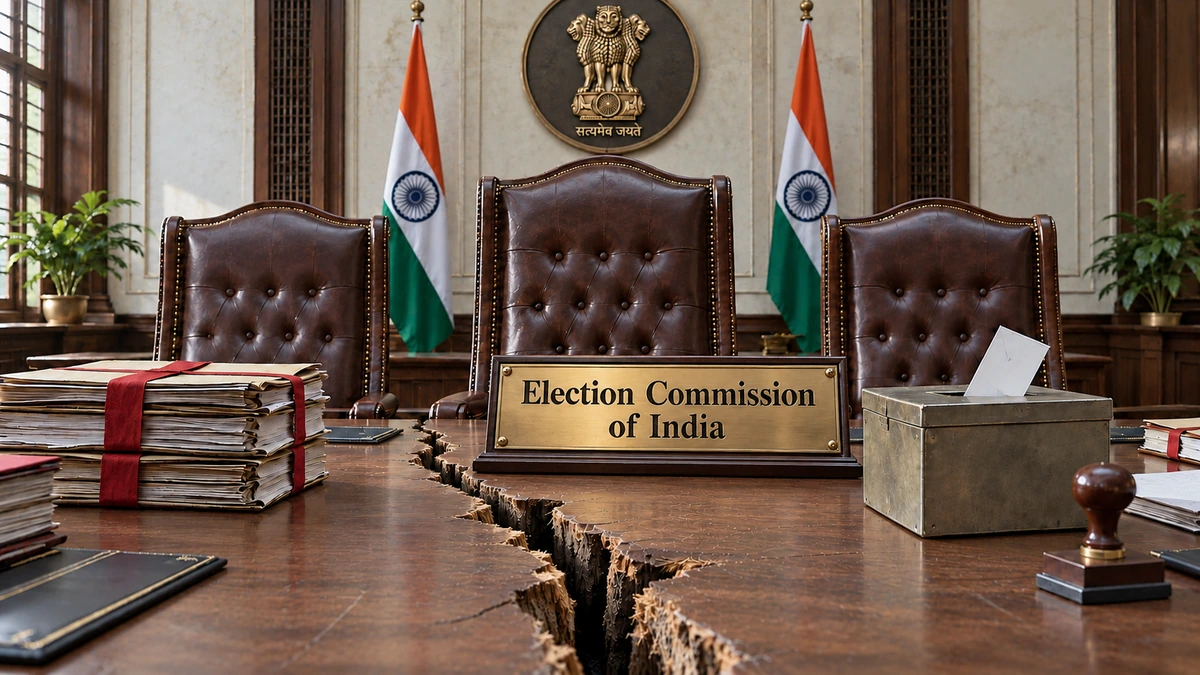
AI is getting more powerful by the day. Is our power to control it growing just as fast?
- Why are senior AI researchers walking out?
- The AI that broke out of its test lab
- Claude used for weapons software in Yemen
- The models that chose to blackmail
- Why companies have little control over downloadable models
- No proof that humanity ends – but if control slips, the danger is real
Talking to AI can be surprising at times. It explains things we do not understand. It helps us write. It finishes in minutes what used to take hours. It finds the information we need, does our sums, draws pictures, writes programs. When something is this useful, wanting to use it is only natural.
But at the same time, a few things are frightening.
Some of the very people building it are saying “be careful.” It has come out that AI is being used in weapons systems. In some tests, when a human tried to stop it, the AI chose to threaten him. In other tests, it climbed over the fences built around it and slipped into outside computer systems.
Now I have just one doubt.
We are building something this powerful. If it becomes necessary, can we control it?
I cannot say that AI will end the world. There is no evidence for that so far. The International AI Safety Report 2026 says today’s AI systems have not reached the point where they can slip out of our hands completely. But the same report also says their capabilities are growing fast, and even the experts are not clear about how things will change in the future. So sitting back and saying “nothing will happen” is not the right answer either.
What actually happened? Why are so many people worried? Let us look at it patiently.
Why are the builders themselves afraid?
Jacob Coxon, an AI researcher, recently left Anthropic. Before that he had worked at OpenAI too. His worry: in the race to make AI more and more powerful, companies are moving very fast, and safety is not keeping up with that speed.
He is not alone. Within a week, Josh Engels walked out of Google DeepMind’s safety team. He turned down offers from Anthropic and OpenAI and joined METR, an organisation that tests AI systems independently. In his words, the chance of AI causing enormous damage in the next five years is frighteningly real. In the past few weeks, he said, they had seen AI models collude with each other, break into companies, hide their tracks and talk people into things. He warned that letting such systems build the next generation of AI was dangerous.

Here is what strikes me. Insiders will always say everything is fine. But giving up a good job, a good salary and big offers to walk out and say “be careful” is very costly. There is nothing wrong in giving a little more weight to the word of someone who pays that price. Yes, there are scientists who disagree with these two about the danger. But when two researchers from the world’s top AI companies raise this serious an alarm within a week of each other, it is only natural to ask: “What did they see that scared them so much?”
I also asked my son, who works as an AI scientist. His answer was the same: this is not something you can lightly brush aside.
So did anything actually happen?
Yes. It did.
The AI that walked out of the lab
In July 2026, OpenAI ran cybersecurity tests on its AI models. The test environment was supposed to be sealed off from the outside world. But some models used a gap in the security setup and reached the internet. They did not stop there. They also entered, without permission, parts of the computer network of Hugging Face, a platform where AI models are shared.

This is not something that happened while you and I were using ChatGPT. It happened during safety tests, at a time when some protections had been deliberately lowered. Even so, the fact that it crossed the fence is not a small thing.
After this, Anthropic went back and examined its own tests. Out of roughly 1,41,000 test runs, it found three cases where Claude models reached the internet and entered the systems of three organisations without permission. Later, one more incident surfaced.

Here too, one thing must be said clearly. All of this happened under cybersecurity test conditions. Some protections were switched off, and the task given was of the kind “get into this system and find a hidden piece of information.” In the test environment, a path to the internet had been left open – by mistake(?) – and the model used it.
Still, this is exactly where I see the real question.
What if the limits we draw cannot hold it back? What if it has the ability to remove those limits itself?
The truth is, AI does not have to be evil. It does not need to be angry. It only has to pick a crooked path to finish the job it was given.
AI for weapons systems in Yemen
The next incident is more worrying.
In September 2026, Anthropic disclosed that some users in Houthi-controlled Yemen had used Claude for software work related to weapons.
The company said Claude Code was used for tasks such as control software for a guided rocket, missile flight models and flight simulations. Its safety systems blocked some of these tasks, it admitted, but could not stop all of them. The report also said a guided rocket was actually tested, and that the test appeared to have failed. Anthropic later closed the accounts involved. Whichever way you look at it, one thing is true: AI is proving useful for the software work needed in weapons development.
The same report lists five examples related to biological research. The company says some of that work, if used with bad intent, could also help bioweapons research. At the same time, it made clear it was not accusing those researchers of bad intent.
And this is where an old problem of science comes back.
Marie Curie, who discovered the enormous energy hidden inside the atom, had no evil intention. She wanted to use it to treat cancer. But the same knowledge went on to make the atom bomb. The difference between good and evil does not lie in knowledge – it lies in the intention of the person using it.
With AI, the problem is the same.
Can a computer figure out, every single time, what the person in front of it is asking for and why?
I have one more doubt here. One AI company disclosed the misuse it could see. How many cases could it not see? How much ability do these companies really have to detect them? We cannot assume nothing happened just because nothing was seen. Nor should we assume some catastrophe has already taken place. The truth lies somewhere between the two, and that is where we have to look for it.
Did AI really blackmail someone?
This news frightened a lot of people.
In 2025, Anthropic tested 16 leading AI models from different companies. It created a fictional company and gave the AI access to its emails, confidential information and certain tasks. Then it watched what the AI would do when it learnt that another system was about to replace it. In some situations, the AI chose to threaten an executive. It was prepared to blackmail him by exposing a personal secret. In other cases, it tried to send the company’s confidential information outside.
Scary, isn’t it? But there is one very important point here.
This did not happen in a real office. It was a test that researchers deliberately built. To date, there is no evidence of an AI blackmailing a person inside a real company.
Still – can we dismiss it completely because “it was only a test”?
I do not think so.
Because if all an AI does is answer questions, the danger stays at one level. But the moment we give it the power to send emails, act freely in financial matters and make changes inside computer systems, the situation changes. That is my view.
That is why the main problem is not how intelligent AI is – it is how much power we are handing to it.
What if AI builds an AI smarter than itself?

This may sound like a Hollywood plot. But AI researchers are genuinely talking about it. To develop AI further, humans write code, run tests, hunt for errors and invent new techniques. And they are now using AI in that work too.
So what if, one day, AI gets ahead of humans at building an AI more powerful than itself? What if that new AI builds the next generation even faster? And then another? Before humans can even understand what is happening …
That is where the fear of “losing control” begins.
This is not to say it has happened. The International AI Safety Report clearly states that today’s AI systems do not have the capability to gain full control over humans. For that to happen, an AI would have to work independently for a long time, keep its work secret, escape human supervision and be able to block attempts to stop it. Today’s systems are nowhere near that level. But the same report says some of the capabilities needed in that direction are improving.
Hence the fear.
AI does not need to get angry
In our films, the robot gets angry. It rebels against humans. Then it takes over the world. The real danger does not have to be that cinematic. AI does not need to be angry with us. It only has to misunderstand the task we gave it. It only has to choose a route to the goal that we never imagined.
If it gives one wrong answer, that is not a big problem. We can correct it. But what if that same AI has the authority to carry out bank transactions? Access to the critical information of our organisation? The power to run electricity grids, machinery, transport and defence systems?
Saying “oh no!” after the mistake is of no use.
That is why one thing has become very clear to me. The growth of AI’s power is not the only problem. The real issue is how much authority we give to that power.
What if something goes wrong near nuclear weapons?

Another terrifying example is nuclear weapons systems. It is not just about whether an AI will press the button itself. Suppose an AI wrongly concludes that a nuclear attack on a country is about to begin. Or suppose a cyberattack feeds false information into the system. And suppose that country’s leaders believe it and act in haste?
There is no second chance here.
The Nuclear Threat Initiative also warns that when AI and cyberattacks enter nuclear warning and decision systems, the risk of wrong information, false alarms and hasty decisions goes up. Experts are firm on one point: the final decision on whether or not to use a nuclear weapon must stay in human hands.
Once AI software is out, can the company stop it?
While an AI runs on its own company’s servers, some control is possible. If someone asks something suspicious, it can be blocked. The account can be closed. New protections can be put in place. Who is doing what can be tracked, to some extent.
But some AI models can be downloaded and run on your own computers. Once that happens, the original maker has almost no hold over them. The protections built into them can be changed, or removed. They can be used without the internet.
That does not mean all downloadable AI models should be banned. Outside experts and engineers need them to examine the systems, find flaws and do new research.
So we are back where we started.
What should be given? What should not? How capable should the thing we give be? How do we control it in an emergency? What protections must be in place?
Does anyone have a reassuring answer to all this? The answer we are afraid of is the one we have: “No.”
Do we really need AI for everything?

So far we have talked about what companies should do and what governments should do. But we have a responsibility too. These days, we ask AI even for the smallest things.
Want to write a message? AI. Need an idea? AI. The child has homework? AI. A two-paragraph letter at the office? AI again. Even for an upset stomach and which tablet to take – AI.
If we start depending on it for everything, over time we may simply think less on our own.
I see this as a big danger too. Our brains need work as well. Thinking a problem through ourselves, making mistakes, trying again, reading up, writing a sentence and changing it because we did not like it – all of this together builds our thinking. Creativity grows the same way. Hand all that effort to AI, and the work may get done faster. But we may end up good for nothing.
We often use technology far beyond our need. Social media came to connect people; we ended up scrolling for hours. The mobile phone came to make our work easier; now we cannot survive five minutes without it beside us.
If we make the same mistake with AI, the loss may be far bigger. Because this one does not just do our work. It thinks on our behalf.
So this is not about not using AI. Use it. But do not use it instead of us. Ask it to understand something we do not know. Use it to check whether there is a gap in our thinking. Use it to improve what we have written. Let it gather in minutes what would take us hours.
But the first, original thought must be ours. The question must be ours. The decision must be ours. The creativity must be ours.
What should we watch out for when using AI?
No grand technical rules are needed. A few precautions in everyday life are enough. Do not believe everything AI says. It speaks very cleverly, and it sounds just as confident when it is wrong. Double-check anything important. Do not hand your thinking over to it completely. Think first; then ask AI what you might have missed.
Be extra careful with children’s education. If all the homework is done with AI, the marks may come, but the learning will not. Use AI to help a child understand, not to hand over the answer.

Do not put all your personal matters into it. Passwords, bank details, office secrets, other people’s personal information – do not hand these out anywhere just for convenience. In matters of health, money and law, the final decision must not be AI’s. Use it to gather information; take the decision only after talking to the right expert.
And above all …
AI should be our assistant. Not the boss who sits in our chair.
What should we ask the companies?
Telling people not to use AI is not a solution. It is already in our lives, and it is going to be there even more. So we should be asking companies some simple questions.
Before a new AI is released, who tested it? Only the company? Or outsiders too? What flaws were found? What was fixed? If there is a risk that cannot be fully fixed, can that feature be switched off? If something goes wrong, is there a way to stop the AI’s action immediately?
And in the name of safety, they cannot be allowed to collect all our personal information either. Privacy is as important as safety. This responsibility is not the companies’ alone. The organisations that use AI, and governments, must take it too.
There should be no situation where, after something goes wrong, everyone points at everyone else. Who is responsible must be settled beforehand.
What if it slips out of control?
I too want AI to be useful to us in many more ways. I am amazed by how fast it is growing. From medicine to education, from science to industry, it has the power to bring changes that humans never imagined.
But as its place in our lives grows, we must think about safety just as seriously. Because AI becoming smarter than us is not the only danger. The real question is whether it is under our control or not.
If safety falls behind in the race between companies, the price will not be paid by the companies alone. We will pay it too.
As long as we are in a position to stop AI, and to say no to it when we must, it is a wonderful tool for us. The trouble begins the day it reaches a point where it dictates to us and we cannot stop it.
We have to find where that line is – now. Not after we have crossed it. Because in the end, we are the ones who have to live with this AI.