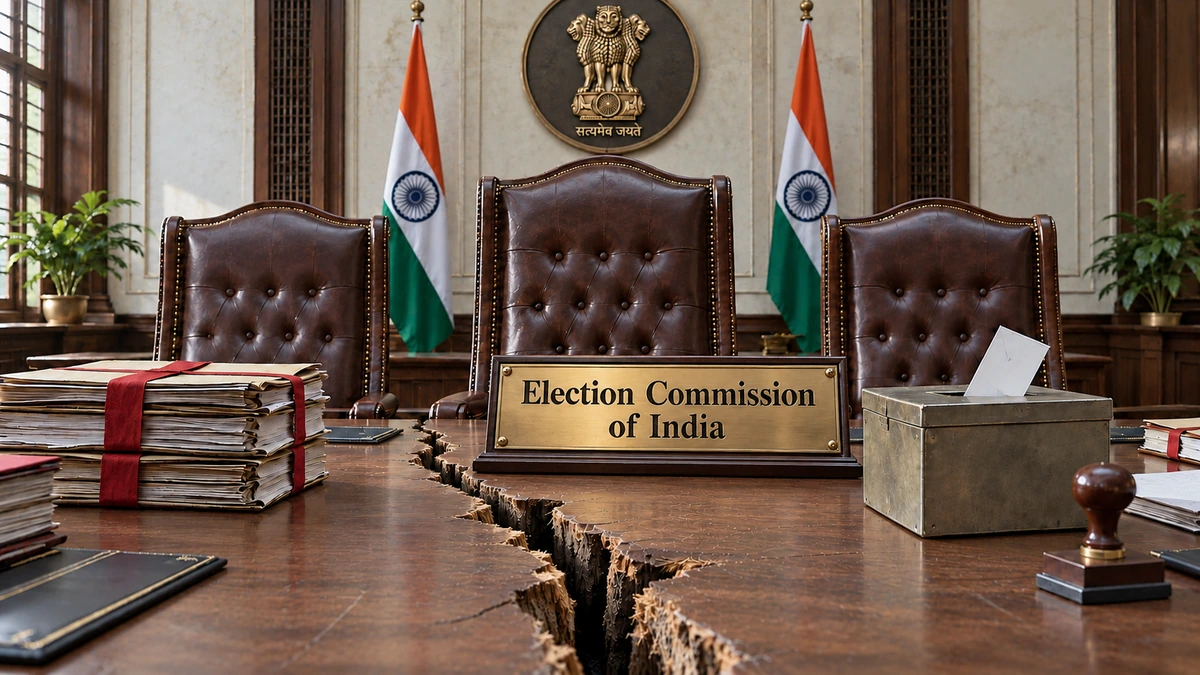
Call it 100 or 112 — thousands of calls come in every day, on hundreds of different needs. Whatever the matter, whoever is calling, one thing must stay secret: who made the call. That should stop at the desk that took it. Everything after that should be done by the computer system, not by people.
One night, one brawl, one phone call
It is past eleven. In a colony somewhere, a quarrel breaks out between two families on the same street. Words turn to abuse, abuse turns to shoving. A crowd gathers. Somebody brings a stick. A resident watching from his window decides that if this goes on, someone will end up in hospital. He dials 100.
The operator asks his name and area. A little later the local police station calls him: “What’s the problem, sir?” He explains. Then the patrol constable calls: “What’s the problem, sir?” He explains a third time.
The constable arrives, picks a face out of the crowd and calls him by name. “Ravi, still not done? There’s a complaint now. Everyone go home.” The brawl ends.
But Ravi lives on that street. He knows the constable. “There’s a complaint” was all he needed to hear; working out who had called took him no time at all. Next morning he is at the resident’s gate. “What business did you have with our quarrel, sir? You called the police on us?”
Will that man ever dial 100 again?
Not a mistake — the method itself
His name and number did not stop at the call centre. They went to the police station, and from there to the constable’s personal phone. Nobody slipped up. That was simply how the old Dial 100 worked: the call-taker noted the caller’s details and passed them to the local station, and the Blue Colts crew rang the caller before setting out. Telangana’s DGP described this old chain himself when the new system was launched.
The brawl is only an example. What if the call had been about a drug racket? A gang stalking a girl? Domestic violence next door? Land-grabbers, illegal arms, extremists? Once the accused learns who reported him, the caller and his family are in danger for the crime of helping the police. And once a neighbourhood decides that calling the police lands you in trouble, the police lose their eyes and ears there.
What America’s 911 does

Dial 911 in the United States and your number is not hidden either. The moment a call lands, the caller’s address and phone number appear on the operator’s screen, and that information flows straight into a central computer system called CAD — Computer Aided Dispatch. The New York Police Department’s own training material says CAD records the caller’s name and callback number along with the operator’s conversation, while the patrol car’s terminal usually receives only the location, the type of incident and the details the officer needs.
So where is the difference? Not in the technology — in the method. The number never travels by word of mouth. Nobody writes it down, nobody forwards it on WhatsApp, nobody calls from a personal phone. Every look at the record is logged. In many states it is law as well: in Florida, the name, address and number of anyone who calls 911 stay confidential with the agency — an officer may see them, but disclosing them is an offence. London’s police contact-centre guidance adds one more rule: staying anonymous is the caller’s right; operators need not offer it, but must honour it when asked.
America is now moving the whole system onto the internet as Next Generation 911 — voice, text, video and phone location, all in one digital record — and with it comes the question of who may see that data. Wherever information gathers, the rules that guard it must be just as strong.
Where our Dial 100 stands today

Some good news first: our system is no longer the old Dial 100. Telangana has retired 100, 101 and 108 and brought 18 emergency services under a single number, 112. Dial 100 out of habit and the call still lands at the same command centre in Banjara Hills.
Reports on the August 2026 launch put the new TG-ERSS 112 at about 18,000 emergency calls a day, of which roughly 7,500 incidents are dispatched to field teams. Some 1,860 patrol vehicles across the state are digitally linked, and the system itself identifies the nearest free vehicle. Artificial intelligence has arrived too: gauging how urgent a call is from the caller’s voice, filtering junk calls, locating the caller, turning speech into text.
With all this in place, picture one scene. A patrol officer is heading to an incident. The address is unclear. He needs to talk to the person who called — no question about that. But does he need that person’s real mobile number to do it?
Book a cab and the driver talks to you without ever seeing your number. Swiggy, Zomato and Amazon delivery riders do the same. The call runs through the company’s computer, and once the delivery is done the link disappears. The privacy we take for granted on a food order is not extended to a citizen who has just reported a drug den to the police.
How it should work

Privacy in the 112 system is not hard. All the patrol officer needs on his screen is one button: Call the caller.
★ It then joins the officer to that call. The two talk.
★ The officer never sees the citizen’s number; the citizen never sees the officer’s.
★ The call is recorded — which case, who spoke, when, for how long.
★ What goes to the station and the patrol vehicle is the incident ID, what happened, where, and how serious — not a name, not a phone number.
★ The summary the caller gave once reaches everyone; nobody tells the story three times.
★ If any officer opens the caller’s real number, that too is logged — who, when, why.
Those who inform on drugs, arms, extremists or gangs deserve stronger protection still.
None of this needs new technology. It is one more layer on the system that already exists — a few days’ work for a team that can read emotion in a caller’s voice. Yet in all the announcements about speed and AI, one line is missing: how far does the caller’s number travel? Nobody asked, so nobody built it.
Happening on every street right now

These Ganesh festival days, the story is the same on every street in Hyderabad. The rules are clear: no DJ, loudspeakers only between 6 and 10 pm. The High Court has said speakers must not face homes, hospitals or schools, and that police must measure noise with decibel meters and act at once.
The streets tell a different story. Cables run from the pandal to the main road, where horn speakers are strapped to electricity and telephone poles. Ear-splitting noise until two in the morning. The constable posted at the pandal looks the other way — he knows the organisers.
Surely someone in the houses around the pandal could dial 100? They don’t. Call, and your name gets out. “He’s the one who complained” is a label that sticks to a street for ten years. So everyone presses a pillow over their ears and waits out the ten days.
That nobody calls about the noise does not mean there is no noise. It means there is no trust.
“A call that never reaches 112 is not an incident that never happened. It is a person too afraid to speak.
The fear does not stop at loudspeakers. On the same street: extortion, stalking, domestic violence, suspicious movements. People see. But the information never reaches 112. The police proudly count 18,000 calls a day. How many calls never come? Somewhere in them may be the tip that stops a burglary before it happens. A girl’s life. Perhaps even the nation’s security.
All the police need to give is one assurance — your name and number will never leave our call centre — back it with the system, and put a plain page on their website explaining exactly how far a caller’s number travels. Everything now locked behind closed doors would reach them. It costs nothing, and it hands the police a rare chance to prevent harm rather than respond to it.
Protecting the caller is policing
There is a command and control centre. More than a thousand vehicles move across its screens on GPS. There is AI that hears danger in a voice. With all this, why must a caller’s number still pass from hand to hand until it reaches the last constable’s personal mobile?
This is not criticism of the police. It is said in the belief that the people who brought the system this far are the ones who can finish it.
A citizen should think, “If I speak, the police will protect me” — never, “If I speak, they will find out it was me.” The difference between those two sentences is valuable information.
Sometimes, it is a human life.