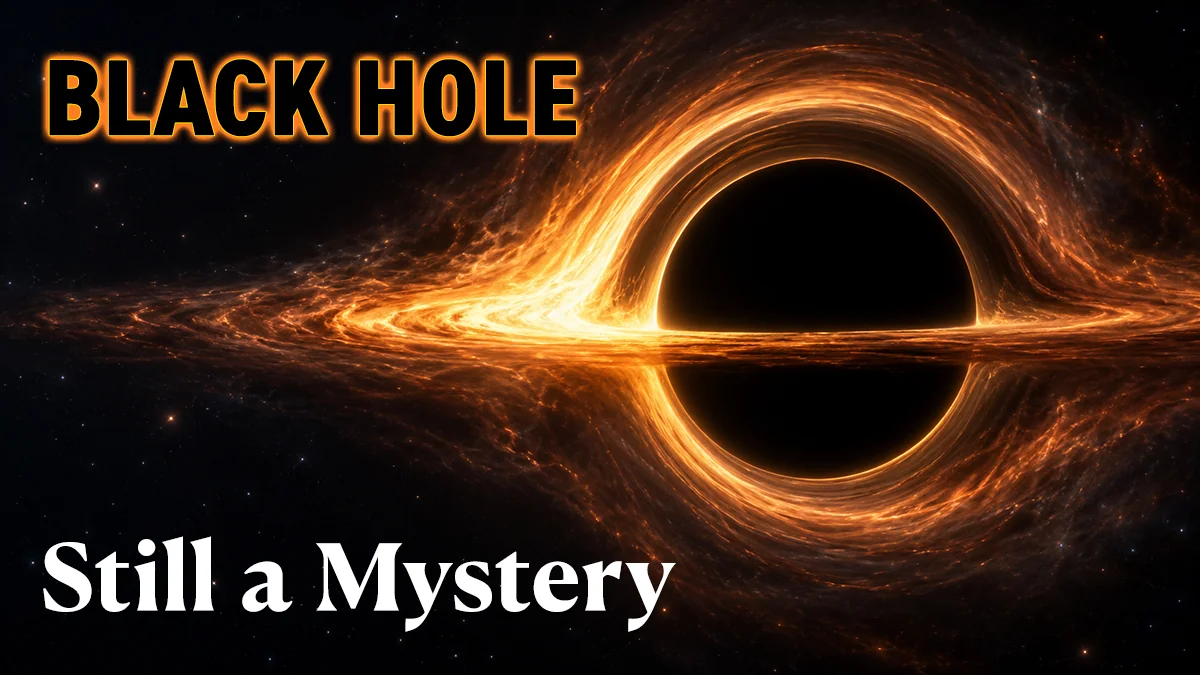
What is a black hole, and what happens beyond its boundary?
Imagine travelling in a spacecraft. Ahead of you is a bright ring of light with a deep, dark centre. As you move closer, the stars behind it seem to bend and stretch. Your spacecraft approaches the darkness.
There is no wall to hit and no door to pass through. Yet somewhere ahead is a boundary you must never cross. Beyond it, there is no journey back. Not even light can return.
This is a black hole.
Is it a hole in space? Does it have a shape? Could it lead to another universe? Could an advanced alien civilisation travel through it? The more we learn, the more questions we find.
When I began reading about black holes, I had these questions too. The equations looked difficult, so I decided to start with things we already know: a stone, a river, a whirlpool and a stretched blanket. Let us use them to explore this strange world.
The basic idea
- A black hole is a region of space from which nothing, not even light, can escape once it crosses a boundary called the event horizon.
- It is not a hole punched through space. It is a three-dimensional region. A black hole that does not spin has a spherical event horizon, rather like the boundary of a ball, but without a solid surface.
- It does not suck in everything around it. Objects at a suitable distance can orbit it.
- We have strong evidence that black holes exist, but we still do not fully understand what happens deep inside them.
Start with a stone
Throw a stone upwards. It rises for a while, then falls. Throw it harder and it rises higher, but Earth’s gravity still brings it back.
In an ideal example, with no air resistance, an object launched from Earth’s surface at about 11.2 kilometres per second could escape without further power. This is called escape velocity. Earth’s gravity does not suddenly end; its pull simply weakens with distance. Rockets work differently from a thrown stone, because their engines keep pushing them as they climb.
This example shows why escaping a strong gravitational pull is difficult. A black hole goes much further. Inside its event horizon, even a beam of light cannot reach the outside universe, and according to our current understanding, nothing can travel faster than light.
A black hole forms when enough mass is packed into a small enough region. The event horizon is its point of no return. You would not find a fence or a solid wall there. It is a boundary defined by the geometry of space and time. NASA
A stretched blanket
Imagine four people pulling the corners of a stretchy blanket. Place a cricket ball in the middle and the blanket dips. Now roll a marble across it. The marble’s path bends as it moves over the curved cloth.
Einstein’s general theory of relativity describes gravity as the bending of spacetime, which brings together the three dimensions of space and the dimension of time. Massive objects such as the Sun change its geometry. Earth follows a path through this curved spacetime as it orbits the Sun. Light follows curved paths too.
Now replace the cricket ball with a much heavier ball of the same size. The blanket dips far more deeply. This helps us picture how a large amount of mass in a small space can dramatically change the surrounding geometry.
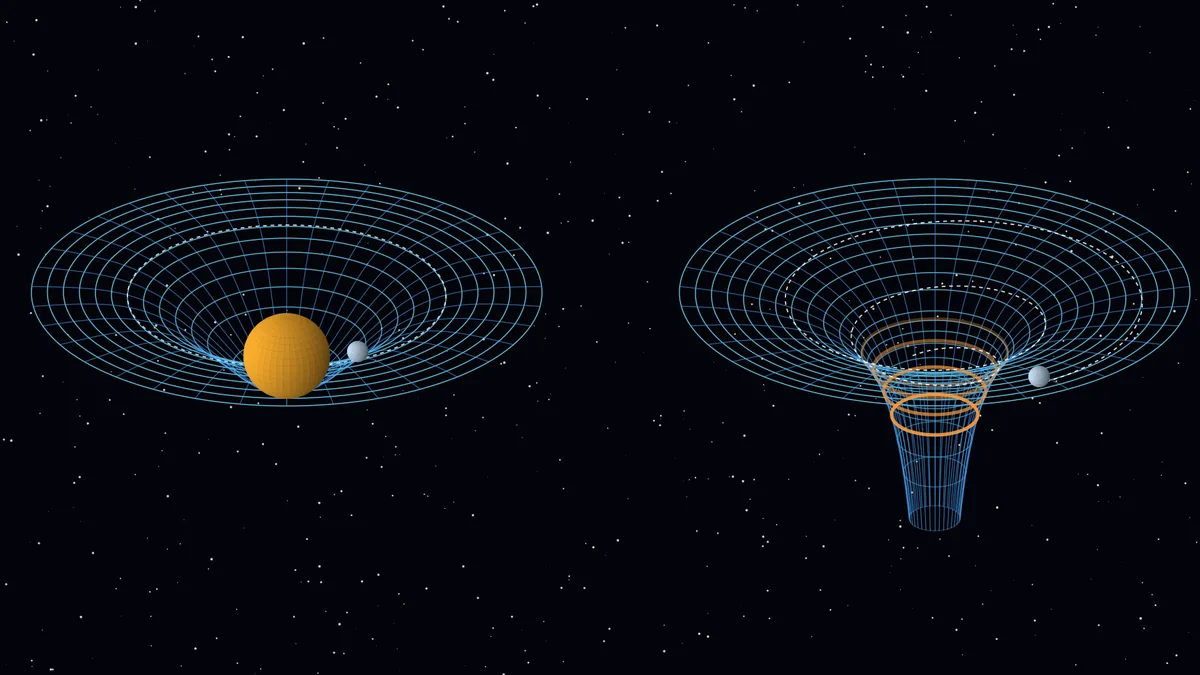
Some drawings turn this dip into a long funnel. The funnel is a visual aid, not the real shape of a black hole. The blanket has limits as an example, too: it is a two-dimensional sheet, and the marble rolls only because Earth’s gravity pulls it down. Real spacetime is not a sheet hanging in a larger room.
A river approaching a waterfall
Imagine you are in a boat on a river that leads to a waterfall. Far upstream, the water flows slowly enough for your boat to travel against it. Closer to the waterfall, the current grows faster.
For a boat with a fixed top speed, there is a point beyond which the current carries it downstream no matter how hard the engine works. The boat is still floating, but it can no longer return upstream.
This is a useful way to picture a point of no return. A black hole’s event horizon is such a boundary for everything, including light. It is not simply a place where you need a better engine.
The comparison is not exact. A river’s limit depends on the boat, and the edge of a waterfall is not a true event horizon. In some mathematical descriptions, spacetime near a black hole can be pictured as flowing inward. That is a model for understanding the geometry, not water rushing through space.

A whirlpool
The swirling water of a whirlpool gives us another familiar picture. Gas around a black hole can also circle it as it moves inward.

But a whirlpool does not have a universal boundary that traps every possible boat, and a black hole is not a giant drain. Use the whirlpool to imagine the motion of surrounding material, and the waterfall to imagine the impossibility of returning. Neither example explains everything about a black hole.
Why is it called a black hole?
It is black because light from inside its event horizon cannot reach us. The word hole suggests disappearance, but it can be misleading. A black hole is a region of space, not a tunnel with an exit at the other end.
The Telugu name, Krishna Bilam, evokes a dark cave. It is a memorable image, as long as we remember that there are no cave walls inside space.
When a star dies
Think of an inflated balloon. The air inside supports its shape against the tension of the rubber. Let the air out and the balloon shrinks.
A star holds a different but comparable balance. Nuclear reactions in its core produce heat, and the resulting pressure resists the inward pull of gravity. This balance can last for millions or billions of years.
When a massive star can no longer produce enough support, its core collapses. If the remaining core is massive enough, it can form a black hole. Not every dying star does this. The Sun is not massive enough to become a black hole. It will eventually leave behind a dense remnant called a white dwarf, which will slowly cool.
Black holes are still being born
Massive stars use up their fuel much faster than smaller ones. The Sun’s main fuel-burning lifetime is about ten billion years. A star with roughly 25 times its mass may live for only a few million years.
Black holes, then, are not just leftovers from the distant past. They are still forming today. Scientists estimate that the Milky Way may contain as many as 100 million stellar-mass black holes, although only a small fraction have been identified.
We also see evidence of very massive black holes in the young universe, within its first billion years. How they grew so quickly is still being studied.
A young Indian scientist and a difficult question
In 1930, while travelling to England by ship, the young Indian physicist Subrahmanyan Chandrasekhar worked on a question about dying stars. He found that a white dwarf cannot support itself above a certain mass, now known as the Chandrasekhar limit: about 1.4 times the mass of the Sun.
This did not mean that every star above that mass must become a black hole. It showed that the support inside a white dwarf has a limit, which helped scientists understand why some stellar remnants must meet a different fate.
The famous astronomer Arthur Eddington strongly opposed his conclusion. Chandrasekhar’s work was later recognised as a major contribution to our understanding of stars. He shared the Nobel Prize in Physics in 1983, and NASA named its Chandra X-ray Observatory in his honour. Nobel Prize
Black holes can grow
After forming, a black hole can gain mass by capturing gas and other matter. Two black holes can also merge into a larger one.
The origins of the enormous black holes at the centres of galaxies are still under investigation. Some scientists also propose that black holes may have formed in the earliest moments of the universe. These hypothetical primordial black holes have not been conclusively detected. NASA: Types of black holes
How large is a black hole?
When we talk about size, we usually mean the size of the event horizon, not a solid object inside it. For a black hole that does not spin, doubling the mass doubles the diameter of that boundary.
If all of Earth’s mass could be compressed into a region about two centimetres across, roughly the size of a marble, it would form a black hole. That does not mean the matter would stay there as an ordinary marble.
For a black hole with the Sun’s mass, the event horizon would be about six kilometres across. With ten times the Sun’s mass, it would be about 60 kilometres across.
Sagittarius A*, the black hole at the centre of our Milky Way, has about four million times the Sun’s mass. A simple non-spinning estimate gives an event horizon about 24 million kilometres across, roughly 17 times the Sun’s diameter.
M87*, at the centre of the galaxy M87, has about 6.5 billion times the Sun’s mass. A similar estimate gives a diameter of about 39 billion kilometres, several times wider than Neptune’s orbit. Real horizons also depend on spin, so these are approximate comparisons.
A boundary can have a shape without a surface
A black hole that does not spin has a spherical horizon. Spinning black holes have more complicated geometry and drag nearby spacetime along with their rotation. Scientists describe these structures with equations, not by inventing a shape. NASA: Black hole anatomy
Why is there light around the darkness?
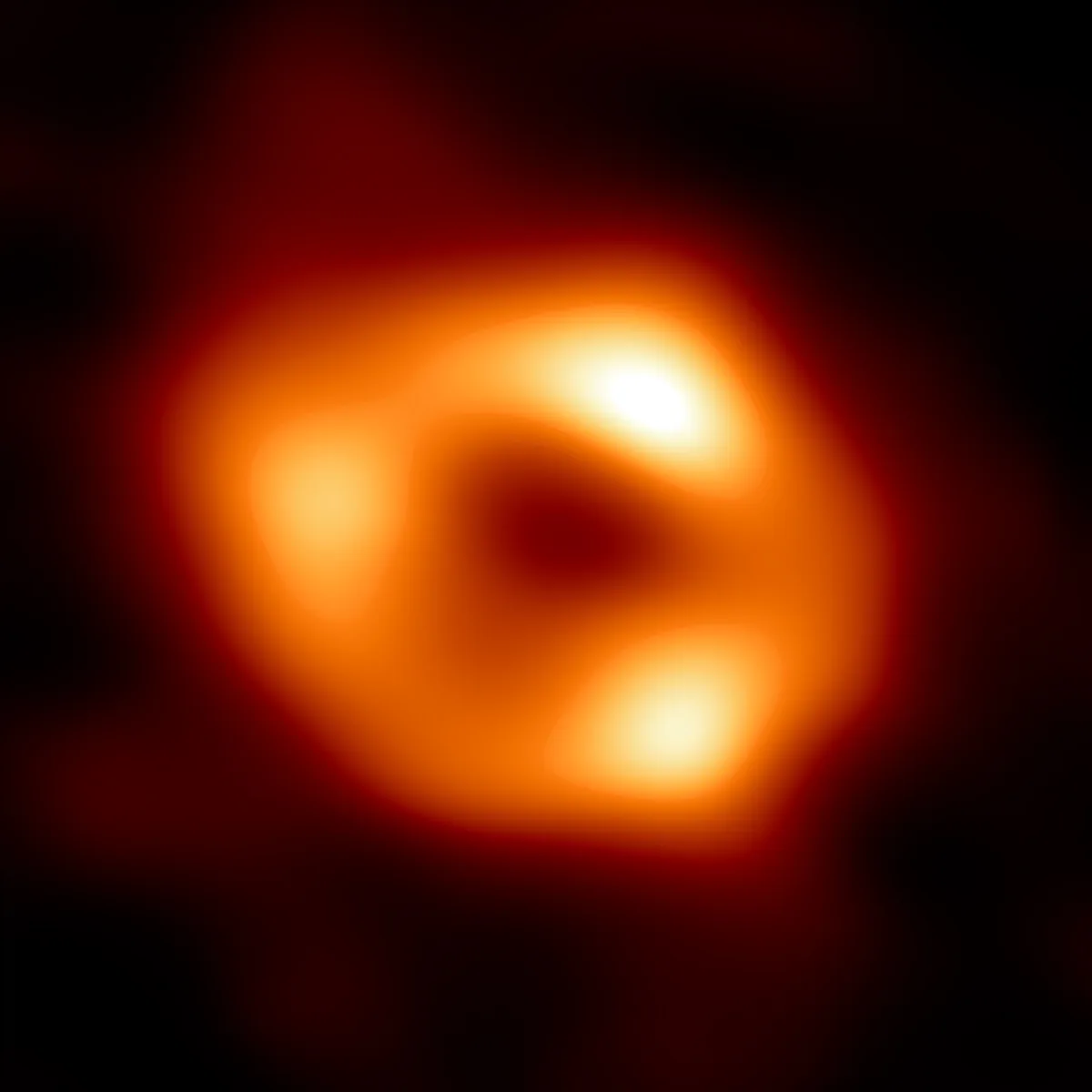
The bright material in a black hole image lies outside the event horizon. It is not light escaping from the interior.
Think of water swirling towards a sink drain. Gas approaching a black hole can also circle it. Friction and collisions within that gas can heat it to extremely high temperatures, making it shine. This rotating structure is called an accretion disk. Not every black hole has a bright disk.
A person standing in front of a bright window appears as a dark outline. In a similar way, light around a black hole can reveal a dark central region. But a black hole also bends and captures light, so the picture is more complicated than an ordinary silhouette.

Light takes a curved path
A spoon in a glass of water looks bent because light changes direction as it passes between water and air. That effect is called refraction.
Gravity also changes the path of light, but through a different process: curved spacetime. This is called gravitational lensing. The spoon helps us picture a changed light path; it does not explain the physical cause near a black hole.
Light from the far side of an accretion disk can bend around the black hole and reach us. That is why some images show a bright arch above and below the dark centre, even though the gas lies in a flat disk.
The shadow
The dark central region is called the black hole’s shadow. It forms because light is captured or redirected away from our view. The shadow appears larger than the event horizon itself.
We are seeing the black hole’s effect on the light around it, not a photograph of its interior.
How do we know it is there?
We cannot see the wind, but moving leaves tell us it is blowing. Scientists identify black holes by their effects on their surroundings. Three kinds of evidence are especially useful.
Stars dancing around an unseen partner
Imagine two dancers on a dark stage. One wears bright clothes; the other is invisible in the darkness. The visible dancer’s movements reveal that someone else is there.
Near the centre of the Milky Way, stars race around a region we cannot see directly. By tracking their orbits for many years, astronomers found that about four million solar masses are packed into a very small region. This research helped establish the presence of Sagittarius A*, and the work was recognised with part of the 2020 Nobel Prize in Physics.
Hot gas and X-rays
Gas outside a black hole can become hot enough to emit X-rays. Space telescopes, including Chandra, detect these emissions. The motion and radiation of the gas help scientists work out what is pulling on it. NASA: How do we know black holes exist?
Ripples in spacetime
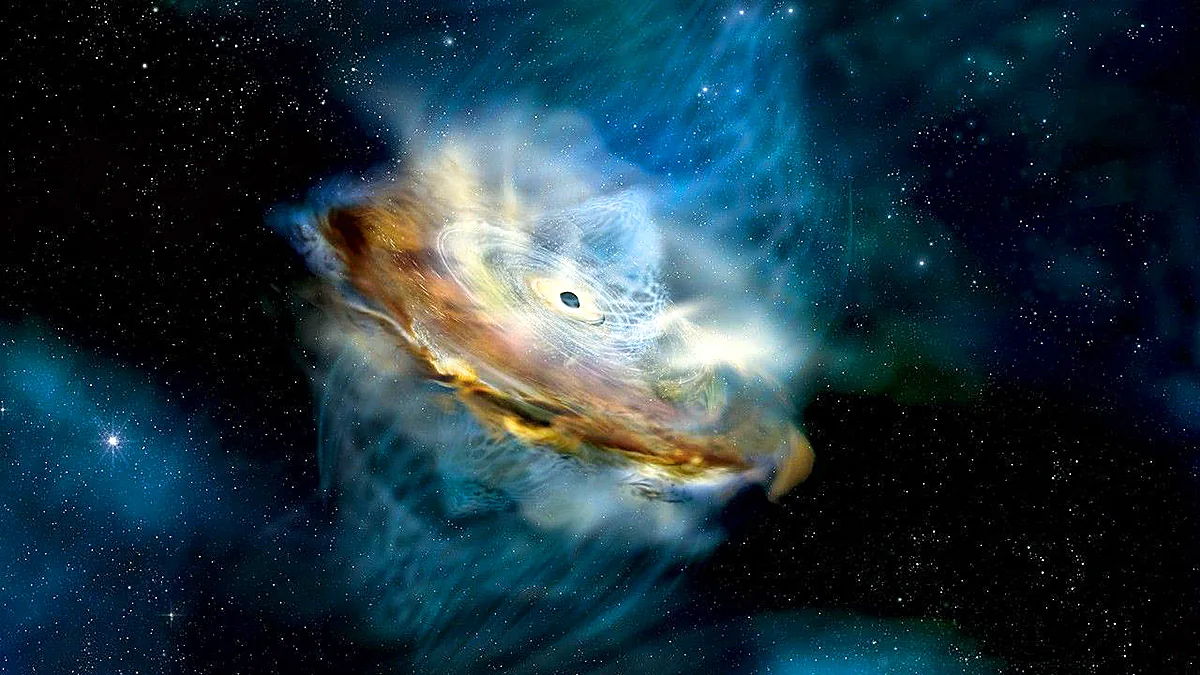
Drop a stone into a pond and ripples spread across the water. When two black holes orbit each other and merge, they produce ripples in spacetime called gravitational waves.
In 2015, the LIGO instruments detected gravitational waves from a black hole merger for the first time. No ordinary sound travelled through space. The instruments measured tiny changes in distance caused by the passing waves. Saying we “heard” the merger is only a metaphor.
A century of discovery
In 1915, Albert Einstein presented general relativity. In 1916, Karl Schwarzschild found a solution to Einstein’s equations that became central to black hole physics. In 1939, Robert Oppenheimer and Hartland Snyder studied the collapse of massive stars.
By 1971, important evidence pointed to a black hole in a system called Cygnus X-1. In 2019, the Event Horizon Telescope team released the first image of a black hole’s shadow, at the centre of M87. Radio telescopes around the world worked together as a single Earth-sized observatory. ESO: The first image

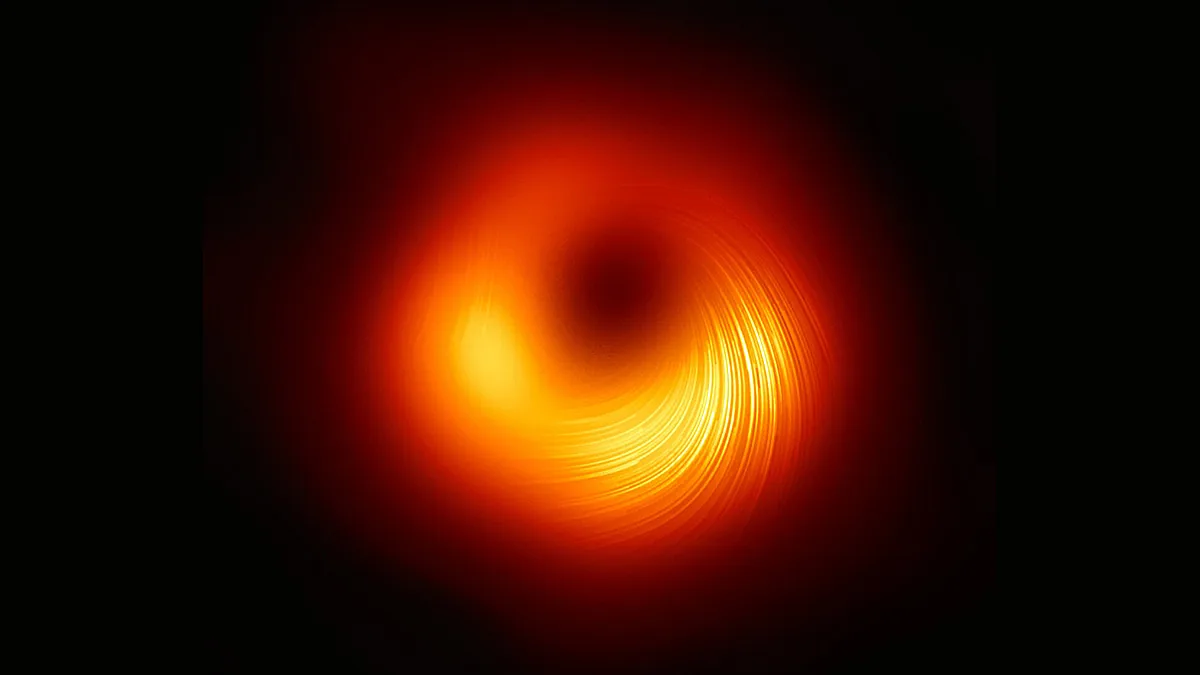
In 2022, the team released an image of Sagittarius A*, the black hole at the centre of our own galaxy.
How close are the nearest black holes?
The Milky Way contains many black holes. Its central supermassive black hole is Sagittarius A*.
NASA identifies Gaia BH1, about 1,500 light-years away, as the nearest known black hole. A light-year measures distance, not time. It is the distance light travels in one year: about 9.46 trillion kilometres.
Sunlight takes about eight minutes to reach Earth. Light from the region of Gaia BH1 takes about 1,500 years. In astronomy, even a “nearby” object can be unimaginably far away.

A black hole is not a vacuum cleaner
A black hole does not automatically pull in everything around it. At a large distance, its gravitational pull is like that of any other object with the same mass.
Suppose the Sun were somehow replaced by a black hole of exactly the same mass. This cannot happen to our Sun, but it is a useful thought experiment. Earth would carry on in roughly the same orbit instead of falling in. We would lose sunlight and heat, and Earth would become very much colder.
Objects can orbit a black hole at suitable distances. Very close to it, strong tidal forces and radiation from surrounding gas can make the environment deadly.
What happens if you fall in?
Imagine falling feet first towards a small black hole. Your feet are closer to it than your head, so they feel a stronger pull. The difference stretches your body lengthwise and squeezes it sideways.
Scientists call this spaghettification, after the long, thin strands of spaghetti. Around a small black hole, these tidal forces can tear an object apart before it even reaches the event horizon.
At the horizon of a supermassive black hole, the difference in pull across your body may be much smaller. Under ideal conditions, you might cross the boundary without noticing anything sudden. That would not make the journey safe or reversible. You could not return, and the interior would still be deadly. A surrounding accretion disk could expose you to lethal radiation even before you crossed. NASA: A simulated journey
What lies in the dark heart?
We said that Earth’s mass would form a black hole if compressed into a marble-sized region. Does that mean the interior is a marble full of matter? Or is it empty?

The marble-sized measurement refers to the event horizon, not an ordinary lump of material. We cannot look directly inside that boundary, so we should neither claim that the interior is empty nor claim to know exactly how the matter is arranged.
For an ideal non-spinning black hole, classical general relativity predicts continued collapse towards a singularity, where density and the curvature of spacetime become infinite in the mathematics. Rotating black holes have a more complicated theoretical interior.
But does an actual infinite density exist in nature? Scientists do not know. The prediction may simply show that the theory has reached its limit.
A blank area on our map
Early sailors carefully drew the seas they knew and left unfamiliar regions blank. The singularity is a little like an uncharted part of our scientific map.
The answer “infinity” may mean that our equations no longer give a complete physical description. At extremely small scales, quantum effects matter. A fuller theory combining gravity and quantum physics may be needed to explain what happens there.
The singularity is a theoretical prediction, not a directly observed object. Nor is it the ground at the foot of a waterfall. That is where the waterfall analogy stops helping.
Could it lead to another universe?
Films sometimes show black holes as tunnels to distant places. There is no evidence that entering one would let you emerge safely elsewhere.
A related idea is the wormhole. Draw two dots at opposite ends of a sheet of paper. Travelling across the paper takes time. Fold it so the dots meet, and you can imagine a shortcut between them.
Some mathematical models allow such structures. We do not know whether usable wormholes exist or could remain stable. A black hole and a wormhole are not the same thing.
Time really can pass differently
Clocks in different gravitational conditions tick at different rates. This is called gravitational time dilation. A clock near a black hole runs more slowly than a clock far away, yet to the person beside it, their own clock still seems perfectly normal.
This is not just a film idea. GPS satellites must account for relativity. Weaker gravity makes their clocks run faster than clocks on Earth, while their speed makes them run slower. Together, these effects add up to roughly 38 microseconds a day. Without corrections, navigation errors would grow rapidly.
Time passing at different rates does not mean we can go back and change the past. NASA: Black hole FAQs
Could aliens overcome a black hole?
An advanced civilisation might find ways to explore or orbit a black hole at a safe distance. But entering its event horizon and coming back out is a different matter.
According to our current physics, no engine, however powerful, offers a route back out. There is no evidence that aliens have crossed that boundary and returned, or that anyone uses black holes to travel between galaxies.
There may be physics we have not yet discovered. That possibility is a reason to keep investigating, not evidence that these stories are true.
Gargantua on the cinema screen
Christopher Nolan’s Interstellar (2014) introduced many viewers to a fictional black hole called Gargantua. Its glowing disk, bent light and dark centre give a striking picture of several ideas discussed here.
Time dilation is central to the story. On one planet near Gargantua, an hour corresponds to seven years far away. When the travellers return to their spacecraft, their waiting colleague has aged 23 years. These conditions were imagined for the film; they are not a fixed rule for all black holes.
Physicist Kip Thorne worked with the visual-effects team. They calculated how light would travel around a black hole and used the results to build the images. Their work also led to a research paper. Research paper
The filmmakers adjusted some brightness and colour effects to make the images easier for audiences to read. Gargantua is therefore a scientifically informed film creation, not a recording of a real black hole. The scenes inside it are speculation and fiction, not established observations. Event Horizon Telescope on Interstellar
The mystery that remains
We have strong evidence that black holes exist. We can measure the movement of nearby stars, observe bent light, detect waves from mergers and produce images of their shadows.
But no message from inside the event horizon can reach us, and we still lack a complete theory of the deepest interior. There is still a blank region on our scientific map.
We can find a black hole. We can estimate its boundary. What nature does beyond that boundary is the part of the story we are still trying to understand.
Watch and understand
To see the life of a black hole, from birth to death, watch this short video.
Read this article in Telugu: కృష్ణబిలం – ‘అంతులేని’ రహస్యం →