Before buying an EV, check whether the support you need is in place
- India has roughly one public charger for every 175 EVs. About a fifth of the installed chargers are not working.
- More than half of Telangana’s charging stations are in Hyderabad. The other districts have far fewer.
- China accounts for 84% of battery cell imports.
- If something goes wrong on the road, the local mechanic may not be able to help.
- My take: city users with the right facilities can consider buying now.
With the US–Iran war sending petrol and diesel prices soaring, many people are looking at EVs to cut their bills. The advertisements make everything look wonderful: a rupee per kilometre, no exhaust smoke, no engine noise.
But think about this. When we buy a petrol or diesel car, we rarely ask whether there will be a fuel station or a mechanic along the way. That network has been around for decades. The equivalent support system for EVs is still taking shape.
Before asking ‘Is an EV good?’, we should ask ‘Are the facilities I need to use it available?’ India is not equally ready everywhere. The situation changes between cities and villages, and between people with their own parking space and those without one.

EVs and Petrol Vehicles: What’s the Difference?
Vehicles powered by petrol, diesel or CNG engines are called ICE vehicles—short for Internal Combustion Engine. Here, EV means an Electric Vehicle powered entirely by a battery.
Here’s how they compare:
| Item | EV | Petrol/Diesel Vehicle |
|---|---|---|
| Purchase price | May cost more than a comparable vehicle | May have a lower upfront price |
| Daily running costs | Usually lower with home charging | Depend on fuel prices and mileage |
| Long journeys | Plan charging stops ahead | Fuel stations are widely available |
| Maintenance | No engine oil and some related costs | Engine servicing is required |
| Major repairs | Battery, motor or electronics repairs can be expensive | Engine or gearbox repairs can be expensive |
| Local repairs | Some work needs specialist training | Repair facilities are widely available |
| Resale | Battery health and warranty matter | Condition and model demand matter |
The Bureau of Energy Efficiency (BEE), under the Ministry of Power, explains that EVs can have lower running and maintenance costs. But we need to count the whole cost, from buying the vehicle to selling it.
More Chargers—but Are They on Our Routes?
According to the central government, India had 52,718 public charging stations by July 2026, with fast-charging facilities at 16,561 of them. That sounds like a large number. Against the EVs on the road, however, the ratio is roughly one charger for every 175 vehicles. In China and Norway, the figure is around one for every 20.
Are all the installed stations working? Apparently not. Of the 27,737 stations installed by March, only 22,753 were confirmed operational. That leaves roughly one in five out of operation.
Closer home, about 600 of Telangana’s 1,063 operational stations are in Hyderabad. The other 32 districts share roughly 460. The government has invited tenders for another 369 stations, but only 169 are allocated across the Warangal, Khammam, Karimnagar, Nizamabad and Adilabad regions. Driving an EV in Hyderabad is possible. Visiting your hometown or travelling to another district for work still calls for a proper plan.
A station may have more than one charging point. They do not all charge at the same speed, and every connector does not fit every vehicle. Finding a charger on an app is only the first step. Is it working? Is another vehicle using it? Can you enter at night? How do you pay? These details matter.
“Knowing a charger exists is one thing. Knowing it will work when you get there is another.
For a long journey, identify a backup charger as well as your first choice. Don’t gamble on ‘There’s a little battery left; we’ll make it.’ If that calculation goes wrong, you’re stuck. Pushing the car the rest of the way is hardly a plan.
Where Do We Stand on Battery Manufacturing?
The battery is the heart of an EV, and its cells are crucial. These small units store electricity and are assembled into a battery pack. Assembling a pack in India and manufacturing the cells here are two different things.
In the last financial year, India imported lithium-ion cells worth ₹41,667 crore; 84% came from China. In 2021, the central government introduced a ₹18,100-crore Production Linked Incentive (PLI) scheme to support domestic cell manufacturing, with a target of 50 gigawatt-hours of capacity by 2026. By October 2025, however, only 1.4 gigawatt-hours of manufacturing capacity had come on stream, and no incentive payments had been released.
Oil imports and battery imports are not quite the same. We burn petrol on every journey. A battery is charged and used again and again. Even so, disruptions in battery supply can affect new vehicle prices and spare parts.
“We need to reduce our dependence on oil while building our own strength in battery manufacturing.
Where Does the Electricity Come From?
An EV produces no exhaust smoke, which helps reduce vehicle pollution in cities. But generating the electricity used to charge it can still cause pollution. Manufacturing batteries and vehicles also has an environmental impact.
So ‘EVs cause no pollution’ is not an accurate claim. Nor is ‘Everything pollutes anyway’ a useful answer. We need to consider how the electricity is generated, how efficiently the vehicle runs and how long it is used.
In an Apartment, Even Installing a Charger Is a Big Job
Charging makes a big difference to an EV’s running costs. People with their own house and suitable parking can install a compatible charger. That usually makes things easier.
In an apartment, getting electricity to the parking space can turn into a headache. You need to speak to the residents’ association.
If you rent, you also need the landlord’s permission. Wiring, earthing, electrical load and who pays the bill must be settled first. Whether a separate meter is required depends on local rules. Running a long extension cable from the flat to the car is not a permanent solution. Have a qualified technician install the charger with the safety equipment specified by the manufacturer. If you move house, can you take it with you? Will the new place have suitable parking? These are questions to ask before buying.
Will It Handle Village Roads?
With home charging and enough range—the distance covered on one charge—an EV can be useful in villages too. How it rides on a rough road depends on the suspension, tyres, ground clearance (the space between the ground and the underside of the car), and the weight it carries. Tyres can wear 20–30% faster than on conventional cars. The battery pack is a major reason: it can account for 20–30% of the vehicle’s weight and adds to the load compared with a conventional car.
Many electric cars carry the battery underneath. A hard strike from a large rock or the edge of a pothole can damage it. Our oversized speed breakers can be a real enemy. A serious hit underneath can mean trouble. Check this during the test drive. For a scooter, try rough roads and slopes with two people on board.
A water-resistance rating does not mean you can drive through floodwater. If your village has frequent power cuts, charge ahead of the next day’s journey.
Stranded on the Highway—Who Do You Call?

Petrol and diesel mechanics are available even in villages. EV support has not yet spread that far. Many roadside mechanics familiar with conventional vehicles are out of their depth when an EV arrives. Some call someone who knows more; others turn to YouTube to learn. India is estimated to need around five lakh EV technical specialists by 2030. The current workforce is put at 1.5–1.8 lakh.
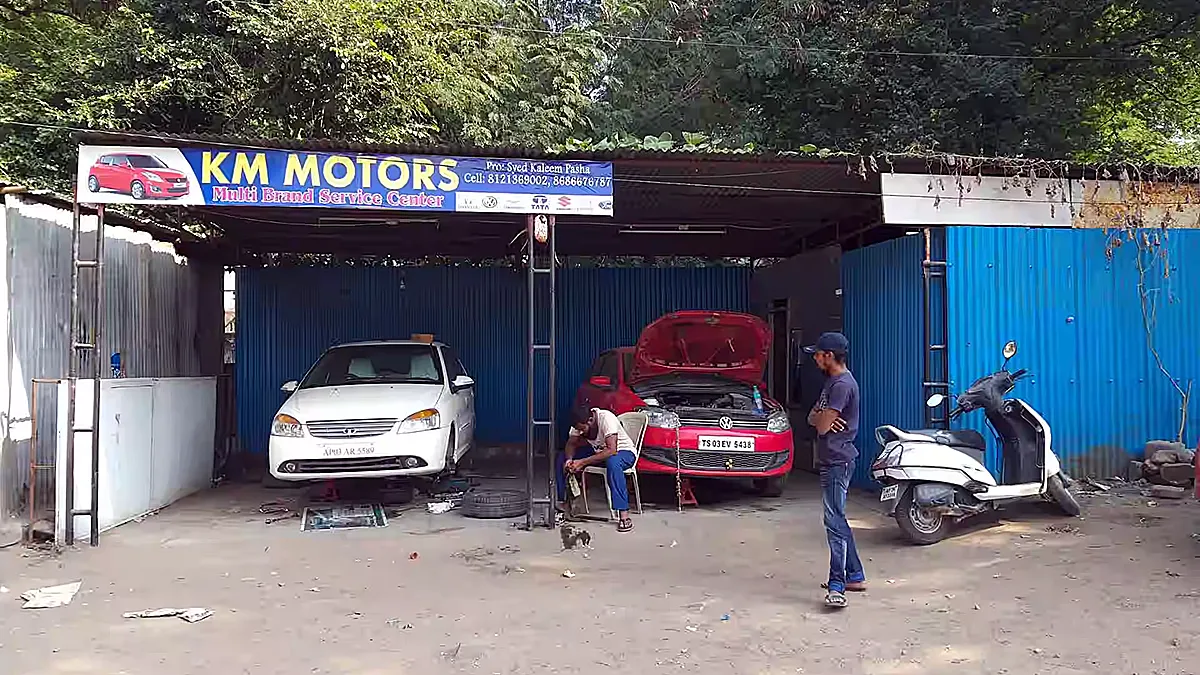
EVs generally have fewer moving parts. That does not mean nothing can go wrong. You may find local help for a puncture, tyres or some routine work. But a fault in the electronics, battery, motor or high-voltage system needs a trained technician.
You may have to call the manufacturer’s roadside assistance. Waiting for help on a highway at night, with your family, is no small inconvenience. If the vehicle needs to be moved, follow the manufacturer’s instructions. Many models need a flatbed truck, which carries the whole car. Don’t simply tie an EV to another vehicle and tow it away.
With a petrol car, the mechanic may come to you. With an EV, you may have to get the car transported to the service centre.
The Cost Calculation: Where Do You Save?
For this comparison, let’s assume petrol costs ₹116 per litre, home electricity ₹9 per unit and public charging ₹20 per unit. These are illustrative prices. Recalculate using your local rates.
Assume a petrol car returns 15 km per litre and an EV covers 7 km per unit of electricity drawn from the meter. At 1,000 km a month, the costs look like this:
| Fuel/Charging Cost | Petrol Car | EV: Home | EV: Public Charger |
|---|---|---|---|
| Per kilometre | ₹7.73 | ₹1.29 | ₹2.86 |
| Per month | ₹7,733 | ₹1,286 | ₹2,857 |
| Per year | ₹92,800 | ₹15,429 | ₹34,286 |
Add any extra public-charging fees. For scooters, assume 45 km per litre for petrol and 30 km per unit for an EV:
| Fuel/Charging Cost | Petrol Scooter | E-Scooter: Home |
|---|---|---|
| Per kilometre | ₹2.58 | ₹0.30 |
| Per month: 1,000 km | ₹2,578 | ₹300 |
| Per year: 12,000 km | ₹30,933 | ₹3,600 |
In this example, the electric scooter saves roughly ₹27,000 a year in fuel and charging costs. How quickly you recover the extra purchase price depends on how much more you paid and how far you ride.
For a car, suppose the EV costs another ₹3 lakh even after concessions. Home charging saves around ₹77,000 a year in this example, recovering that extra price in about 3.9 years. Relying entirely on public charging stretches it to roughly 5.1 years. That is only the fuel and charging calculation. Loan interest, insurance, servicing, repairs and the value lost when you sell can change the result.
The full calculation: purchase price + loan interest + charging setup + running costs + insurance + maintenance − the amount received when you sell.
You can also use the government’s EV cost calculator to compare options using your own figures.
A Low Upfront Price? Check the Battery Rental Too
Some schemes advertise a lower starting price by keeping the battery cost separate. You then pay battery rental for the kilometres driven. Electricity costs come on top.
MG says battery rental for the Windsor Pro starts at ₹4.50 per kilometre. Read the terms on minimum monthly billing, financing and leaving the scheme early. A price that includes battery ownership and a battery-rental starting price are not directly comparable.
There’s a Battery Warranty. For How Long, and on What Terms?
Many electric cars have long battery warranties. But the years, kilometre limits and loss of capacity covered vary by model.
What does ‘lifetime’ mean? Is it only for the first owner? How much cover remains if you sell the car? Tata and Mahindra terms change the warranty limits when ownership changes.
The battery does not fail the day its warranty expires. Nor does every fault require a complete battery replacement. But a major repair outside warranty can be expensive. If you are buying a used EV, check the battery health report, service history and remaining warranty.
Range: Don’t Plan a Trip Around the Advertised Number
The range achieved in a test can differ from what you get on the road. Speed, air-conditioning, weather, gradients and weight all matter. Advertised figures are obtained under standard conditions using specified test procedures.
For example, Tata estimates a real-world range of 335–355 km for the Punch.ev with a 40 kWh battery. That is the company’s estimate, not a promise for every trip. Test-drive on your usual route and leave room for an unexpected journey when choosing your battery size.
Which Models Can You Consider?

For a small car, look at the Tata Tiago.ev. For a compact family car, compare the Punch.ev and Nexon.ev. The MG Windsor is an option for space and comfort. In the SUV segment, consider the Hyundai Creta Electric and Maruti Suzuki e VITARA; with a larger budget, look at the Mahindra BE 6, XEV 9e and Tata Harrier.ev. BYD and the recently introduced Tesla models are other options.
For a family scooter, consider the TVS iQube, Bajaj Chetak and Ather Rizta. This is not a ‘best EV’ ranking. Choose based on local service, the full price, the right variant and your test drive.
Don’t Rush Because a Concession Is Ending
Telangana offers a 100% exemption from road tax and registration fees for EVs. The road tax on a ₹10-lakh petrol car is roughly ₹1.4 lakh. The EV exemption is due to end on 31 December 2026, and the government has not yet announced whether it will be extended. Booking is not enough: registration must be completed by the deadline.
The central government offers an incentive for eligible electric two-wheelers under PM E-DRIVE. There is no central purchase subsidy for cars under that scheme. Concessions depend on the vehicle category, scheme conditions and purchase or registration dates. Ask for the concession applicable on your purchase date to be shown in writing on the bill.
A concession is a useful benefit. But encouraging sales does not prove the infrastructure is ready. If you have no home charging and no accessible service centre, buying just because a deadline is approaching could be an expensive mistake.
My Take: Not Yet the Right Time for Many Buyers
Chargers, battery manufacturing, mechanics, service centres—the system that supports EVs is still not fully ready across the country. In my view, this is not yet the right time for many buyers. I expect India could need another four or five years to become ready more widely.
The exception: buyers with charging and service available. If you have safe home charging, a nearby centre equipped for EV repairs and enough range for your daily travel, you can consider buying now. These facilities matter for both scooters and cars. Use the charger recommended by the manufacturer, and do not charge where it blocks an exit. If your travel is mainly between home and the office in the city, an EV can fit that routine.
Others should wait. If you depend entirely on public chargers, frequently travel to places or along highways with limited charging, or have no nearby EV service centre, waiting is sensible. If you need a vehicle immediately, compare petrol, CNG and hybrid options and choose what suits you. There’s no need to feel you are buying yesterday’s technology: these vehicles are not disappearing overnight.
I am not suggesting you wait because prices are guaranteed to fall. Nobody can promise that. Wait until charging near home, chargers on your routes and dependable service when you need it fit your circumstances.
Seven Things to Check Before Buying
1. Full price: Get a written quote covering the battery, charger, installation, insurance and taxes.
2. Charging setup: Have the electrical supply at your parking space checked before buying.
3. Battery warranty: Read the time and kilometre limits, capacity threshold and exclusions.
4. Roadside assistance: How far does the cover extend? What costs extra?
5. Service: Locate a centre equipped for EV repairs, not just a showroom.
6. Range on your route: Test-drive with your family and normal air-conditioning use.
7. Your calculation: Compare total costs for your annual distance and intended ownership period.
One More Word
EVs are part of our future. But that future is still not visible in every Indian village. Governments are encouraging purchases through concessions. Chargers, battery manufacturing and repair support are lagging behind. The cart is moving ahead of the horse.
Don’t buy on the strength of an offer. Look at your parking space, daily route and journeys to other towns. If the charging and service facilities you need are available, consider buying now. If they are not, waiting is the wiser decision.
The cost tables are illustrative. Recalculate at the time of purchase using local prices, actual usage and the terms of the model you choose.